
Five cycles in
In March 2025 I started an MBA at Augment, an online school built around entrepreneurship where the classes are taught by operators rather than academics: the founders of YouTube, Waze, Wikipedia and Shazam, and people who have run things at Google and OpenAI. Self-paced, about three thousand, and no need to leave my job. It did not come cheap, but I wanted exposure to entrepreneurship and access to a network of like-minded people.
That is not the interesting part. The interesting part is that I knew, sitting there having paid, roughly what was going to happen. I would go hard for a month. I would pass on a module, a second one, maybe three. And then something else would come along, and I would leave the MBA at 80 or 90%, which is where I used to leave most things.
That is the pattern I have had my whole life. I start a great deal. But I often do not finish. I don't usually abandon anything outright, I just stop short of the end, and I have almost certainly lost a lot of things that way. This is not even a matter of difficulty. I usually enjoy going through the hard part of the journey. But once I’ve got the finish line in sight, I tend to lose interest and don’t bother with the final details.
So, I went looking for a mechanism, found a book called The 12 Week Year, and ran my first cycle alongside the MBA.
Eighteen months later I have five completed cycles written up, a sixth starting now, after a four-month gap where I ran nothing at all. This is what the record says.
Productivity has become a trendy word. We are surrounded by self-development books, inspirational podcasts, guide-to-deep-focus videos. And yet almost all of them treat productivity as a way of living rather than as a tool you pick up when you need it. For me it matters when your life is already full and you want to optimise the time you spend on certain things. That is the whole of it.
There are moments when you should be productive and moments when you should take the thing in front of you for what it is and enjoy the time you take doing it, whether or not it has been properly optimised. When you spend time on something relaxing, don't file it as productivity. Worse, don’t feel guilty for enjoying the moment. File it as what it is, which is an activity that lets you detach from a particular intellectual or physical effort, or at least, feel like none of these in the moment. Those rest phases are exactly what makes the working phases work: this is a balance.
Failing at New Year’s resolutions
Every single year starts the same way for many of us: we make a few resolutions that are meant to turn our life around, within a year. This is usually followed by a few weeks, sometimes months for the bravest amongst us, of strong commitment and high effort towards these new annual goals. We feel good. We’re on track. We’re even ahead of what we had in mind.
Of course, we started too strong. So, we break down a little, and instead of going five times a week to the gym, we start going three. And because we indulge ourselves, this becomes two weekly sessions until it goes all the way to sporadic visits. We do not cancel our gym membership: for sure, it is only a matter of weeks before we commit again.
Then October or November arrives. We start thinking of our Christmas plans and suddenly remember we made ourselves a promise at the beginning of the year. Two options here: either we push it back to the next year, well aware there is not enough time to squeeze it all in the last few months left, or we push hard to get as close as possible to the outcome we had in mind.
In the former instance, we just keep repeating the same pattern year over year and achieve nothing. In the latter, we squeeze a goal meant to be achieved in one full year into a few months, having really worked on it only at the very start and the very end. In both cases the system is not working the way it was meant to.
The 12-Week Year is meant to provide a method to help both. The core principle around which the whole methodology is built is that humans have a terrible perception of time and cannot plan over an entire year. It is too forward looking, with too many uncertainties over the period: how many amongst us know how busy they will be in 6 months from now? 12 months from now? You may have a bit of an idea if that falls during the summer holiday or the Christmas period. But you do not have full visibility on your workload, social life, and even less on your energy levels at that time.
The authors of the 12-Week Year argue that the correct period to consider objectives is over 12 weeks. This is long enough to be able to accomplish, or at least give it a go, challenging goals while short enough to have in sight both the finish line and, almost more importantly, the departure line. Why the departure line? Because we can see we did not start that long ago and it was not such an effort. Also, because our objectives are still fresh in our mind that way: we do not lose track of what we were meant to achieve over that period.
Before jumping on a calendar and setting up objectives, the book recommends a first longer step, which won’t have to be repeated for future cycles if you do it right the first time.
The ten-year question
Underneath the entire methodology sits a hierarchy I would not skip, because objectives with nothing above them drift. Start with an aspirational vision at ten to fifteen years, in at least 300 to 500 words.
Describe your ideal life with no constraints of time or money. Don’t censor yourself. But be true to yourself. What do you actually want in life?
What looks like a very easy question turns out to be a deep introspection. The first answer is almost always related to physical goods we would buy. Stupidly expensive ones in general. And as we spend more time reflecting, we push back that first idea down and down and down the list. Until it often disappears from our vision, for most of us at least. It comes down to more real things, often less material. This is what sits at the top of most of us: happy time with people around us. The big question is therefore how we spend that time, and the answer is very different from one to another. And who we spend that time with. Again, this answer is unique for each of us.
I am not saying there is no material possession in this vision. They are however not central to the vision for most individuals. They serve as a means to something else: comfort, security, convenience, etc. In any case, be wild in your thinking but remain genuine: this is your personal idea of happiness not one imposed by society or projected by your relatives. This step alone could keep you busy for a few hours. I’d even recommend doing it over a few days, coming back at it every other day, to have time to properly sleep on it and ensure you’re manifesting your true desires.
Once completed comes another lengthy step: turning that vision into a plan. The vision will act as your personal North Star, the one thing guiding you throughout your life. Your objectives, from now on, must be directed, for most, towards achieving that vision.
This starts with breaking that vision down into objectives at ten years, five years, three years, one year, eventually six months. It would not be realistic to set a 10-year objective over a 12-week cycle hence the funnel approach to it. We build up towards each longer-term objective.
Two questions, from Intel to Google
We now know where we’re going. We’ve answered half of the questions that former Intel CEO Andy Grove sees as the heart of any successful system of objectives. In his book High Output Management, he argues that one must answer two questions:
Where do I want to go? And how will I pace myself to see if I am getting there?
These two questions helped Grove successfully transition Intel from a memory company to a microprocessor company in the mid-1980s, allowing him to become CEO a couple of years later. They constitute the spine of management by objectives (MBO), or what is today better known as Objectives & Key Results (OKR).
While dating over half a century now, this goal-setting framework has been more recently popularized by John Doerr, a former engineer turned product marketer at Intel, who took one of Grove’s internal management courses. By 1999, John was working for the VC firm Kleiner Perkins. Following a $12.5m investment in a young and promising startup, he introduced this concept to its management: Sergey Brin and Larry Page, who just had co-founded Google. This quickly became the core of Google’s culture and OKRs have grown incredibly popular thanks to the outstanding growth and successes of the group. John Doerr eventually published Measure What Matters in 2018 to explain this methodology in more detail.
A word on where I learned this, because it matters for what follows. I did not do the MBA for the credential. I have a degree from a French business school and a career that has gone fine without another one. What I did not have was any idea how to run a business. I had vague ideas and no notion of where to start, what to look at first, or what I was failing to consider.
Augment was aimed at professionals, focused on entrepreneurship rather than leadership, cost a fraction of an executive MBA, and was self-paced, so I did not have to stop working to do it. Those four things, in that order. The single most useful thing in it was a leadership class by Ann Hiatt, who was Jeff Bezos's executive business partner and later the first chief of staff at Google. That is where I properly learned OKRs.
Everything in this article that sits on objectives and key results, I learned there and then applied to my own life rather than to a company. The marketing classes were the other thing worth the money, largely because I studied finance and had never looked at marketing seriously in my life. The honest version, since I am mentioning it: it is too high level. I understand the design choice, because the point is to get you acting rather than reading, but I would have taken far more content, and textbooks. But too much theory is also what prevents action: thinking things over and over instead of starting. The key lesson from all these entrepreneurs turned instructors for Augment was always the same:
“I figured it out on the go, as problems arose.”
Just for that, I have no regret.
What it gave Dantes specifically was a why, the habit of asking what a user would actually want, and the push to do any marketing at all. That is real, and it is also less than it sounds, because I could have got most of it on my own. So: not for academics, and not for anyone who has already been through a generic business school, where the overlap is large. It is for someone from a non-business background who is ready to act on a project and only lacks a few concepts.
And the part that belongs in this article rather than in a review. I would not have finished it. Some modules were not relevant to me. There were weeks where the whole thing felt pointless because I had no startup to apply it to. Without the 12-week cycle I am confident I would have stopped after a handful of modules, which is exactly what I have done with most things I have paid for.
Unsurprisingly, the 12-Week Year strongly recommends using OKRs for the next step. We’re now looking forward 12 weeks only and must identify objectives fitting with our longer-term goals: they are intermediary steps towards those. The OKR approach is very clear on what is a good objective.
The counterintuitive part is that an objective must be significant. This means not something easy to achieve. We would need to work extra hard to even hope to complete it at 80%. John Doerr even says it must be aspirational. Therefore, apply a bit of wishful thinking when setting up your goal.
Careful though: the objective must also be concrete and clearly defined. No vague goal such as the classic “Lose weight”. I mean, you can decide to lose weight, naturally. But be precise: why do you want to lose weight? What are you trying to achieve by losing weight? For some, this may be related to a specific upcoming competition. For others, this could be part of a healthier lifestyle that would allow them to do more things. Write the real objective, not the intermediary step: we will focus on these steps in a bit. Google’s own article on the topic is very helpful to understand how to draft objectives following this framework: I’d encourage you to have a read through to help you write better objectives.
Now, we’ve got only 12 weeks to achieve these objectives. It is therefore recommended to limit to three to four objectives over the period rather than spreading ourselves too thin and failing at all of them, or focusing on a couple and eventually ignoring the others. Limiting ourselves from the inception of a cycle also forces us to prioritise accurately and assess what is required to meet our longstanding targets.
I also try to add diversity in my objectives in order to cover a wider part of my life. Currently, I’ve got an objective capturing my work on this blog (yes, this article is contributing towards it), another one related to my professional career, a third more related to health and daily energy, and a fourth, more minor, to put me back on track with my reading habit.
Objectives are great but without a way to measure progress, they will remain useless, just like our yearly resolutions. The OKR framework therefore associates each objective with a few key results, usually three. Key results articulate measurable milestones, which will directly advance the objective. They describe the output rather than the activity. Think of them as an action plan.
If we were to come back to our weight-loss example, we could have the following key results, all measurable:
-
Track calories and achieve a 500kcal daily deficit.
-
Train four times a week for at least 45 minutes with two cardio sessions and two strength-based sessions.
-
Decrease my body fat percentage from X% to Y%.
These targets must be ambitious as we’ve just discussed but don’t be unrealistic either: that will only discourage you when you see how far off you remain, week after week. Progress must be made.
The weekly ten minutes
We’re now done with the setup. This takes a bit of time, especially for the very first cycle. The OKR framework will need to be reworked at each new cycle, but everything else is likely to remain pretty stable over time. This does not mean you should never revisit your vision and longstanding ambitions. However, if you executed that part with due care, taking a week to think it through and being genuine, it is unlikely that you will change your mind after twelve weeks only. Or even a year.
With a clear plan written on your paper, you know what to focus on for the next 12 weeks. For the system to remain efficient, it cannot solely rely on that plan you just made. It requires maintenance. More precisely, short weekly maintenance. At the end of each week, sit down and take stock, 10 to 15 minutes, answering the following questions:
-
What did I do?
-
What should I have done?
-
Is there anything I should have done better?
-
Or, on the contrary, something I put in place that works well and that I should repeat next week?
Then three to five actions per objective for the week ahead and a rough sense of when in the week each one fits. Feel free to schedule slots in the calendar if it helps: I do not do it as I prefer flexibility.
And a rule I would keep even if you keep nothing else: add 30 to 50% to every time estimate you make.
This may sound like an extra step with little value. It nevertheless ensures that you never lose track of what you’re achieving while keeping in mind your objectives. Some weeks will have been busier than others, so you may need to work a little more the following week to offset the time lost. You may have spent too much time on an objective to the detriment of another. Here again, this is a good opportunity to notice it and correct. The only rule for this reflection session is to remain honest on what you achieved and what did not progress. This is also the time to spot any pattern in your work habits or energy levels.
At the start the progress will look minor, and that is normal. Do not forget that you set ambitious targets. You may never come that close to full completion. A good rule of thumb is that you should be happy to reach 80% completion by the end of the cycle: this would have been a lot more progress than if you had set for yourself an easier target. And completion can just occur at the next cycle… except that by then, you will have set an even more ambitious target, so the 100% of the previous cycle will only be an intermediary step of this new cycle.
Week 6 is a longer mid-point review, for an hour. This is the one that saves cycles. Life gets in the way, and not usually in dramatic ways: it is the ordinary difficulty of holding a social life, a job and personal projects in the same three months. When that happens I recut the objectives at week six rather than writing the cycle off. You still finish having moved, even if you didn't arrive, and anything still relevant carries into the next cycle. Adjusting is not failing. I have more than once removed one of my objectives to concentrate on the other two or three. It always paid off, as long as I had been giving it a proper shot. No failing without trying.
Week 13 is the full retrospective, and it feeds the next cycle. Reflect on the past 12 weeks. How far did you go? What challenges did you face? Where did you fail and why? Anything you would have done differently in retrospect? To the contrary, anything you should keep doing for the next cycle? What drove your energy up and what drained it?
Two things it changed, and I put them above any of the outputs. I stopped abandoning things at the eighty per cent mark. And I stopped the productivity yo-yo, the "I worked well this week so I can ease off next week" cycle that guarantees the November problem with resolutions. This is how I got Dantes online and how I make sure I work on it every week, whether it relates to curation of resources or writing for the blog.
I should also say what it is not. I have never done this in monk mode. I kept the social life, the evenings out, the weekends. That is not a caveat bolted on at the end, it is the point.
Travel is the real threat, more than any deal or deadline. I travel a fair amount, often at weekends, and it does break objectives. What survives is the review itself: Sunday if I'm home, Monday if I get back late, which is fine. Some objectives can be done on the move, or a reduced version can, so I do the reduced version. Cycles matter and flexibility matters just as much. You cannot plan a whole life, and planned hiccups are still hiccups.
Claude: my commitment partner
I've found AI particularly useful for implementing and maintaining this framework. I built a Claude skill that acts as a coach at each step of the 12-Week Year. Set up properly, it becomes a brutally honest sparring partner that takes none of your white lies. Configure it softly and it will be soft with you, which makes the whole exercise pointless.
What that buys you is the thing I did not expect. It is very good at spotting when you are not being honest with yourself. On the cycles where I was not progressing on the physical objectives, the numbers were unambiguous and I had reasons for all of them, and it simply told me they were excuses and that I had control over most of it. It was not pleasant to read but it was the truth. It has also caught me, more than once, in the act of drifting toward a shiny new project, which is precisely the pattern I built the system to stop.
It is not always right, and I would not want to give the impression that it is. It does not have all the context. During one cycle I injured myself training for a marathon and it kept pushing me to find some way to keep training, which was not physically possible. For once I had a genuinely good excuse, and that was the one time it wouldn't take one. Keep your own judgement above it. Otherwise, what is the point of being human?
Have I been tempted to game it? Obviously, everyone would be. But if I pick softer key results because I know I will be asked about them, then the 10 to 15 minutes a week I spend on this is time spent being kind to myself in writing, which is worth nothing. Nobody is making me do this. So, either I do it properly or I don't do it. When I did find myself gaming it week after week, because the motivation had gone, I stopped the cycle. Not after one bad week though: be flexible with yourself. But if it goes on for a few weeks and you can see you are neither progressing nor following it, stopping is the honest move and gaming it is not. It would just be a waste of time.
Does it feel like anything? Accountability, yes, though less than you would think. Judgement, technically, because I configured it that way, but it is not a person, and I don't much care what it thinks of me. It behaves like a mirror. When you put on weight the mirror tells you, without malice and without an opinion. This is the same, except it is not only for weight.
Real accountability, for me, comes from people. I share the objectives with my wife and with some friends. On sport there is a WhatsApp group where a few of us post what exercise we did that day, if any. Since we started it, all of us are training more. You cannot run a group like that for every objective, which is the gap Promethee's guilds are trying to fill, and it is the right idea. I will come back to that software after.
At that point, you may be wondering what a skill is and how to get started. Strip away the branding and a skill is a folder containing a markdown file called SKILL.md. That's it: a text file with a .md extension. At the top sit a few lines of YAML (data serialization language that is often used for writing configuration files), giving a name and a description, and below that, plain English instructions telling Claude how to do one specific job. While I refer to Claude throughout this article, this can be replicated with any other AI of your choice. Just copy paste this article and ask your own AI how it could duplicate the framework – I also share my own files (emptied out of personal data and my more customised features) at the end of this section, which can be fed to any AI.
This is where I got it wrong first time: I built a single "12 Week Year coach" and it was mediocre at all five jobs, because vision-setting and Sunday scoring need completely different instructions. Focused skills compose while one large skill doesn't. The framework has five stages, so the pack has five skills:
| Stage | When | Writes |
|---|---|---|
| setting-vision | Once, revisit yearly | Vision/Vision.md |
| planning-a-cycle | Every 12 weeks | Cycle N/Preparation/OKRs.md |
| reviewing-the-week | Every Sunday | Cycle N/Weekly/Week_N_Review.md |
| checking-mid-cycle | Week 6 | Cycle N/Midcycle_Review.md |
| closing-a-cycle | Week 12 | Cycle N/Retrospective.md |
Look at that last column, because it's the whole trick. Each skill writes a file. The next stage reads it. The vision document is what cycle planning is judged against. The OKR file is what Sunday scores against, which is why a target can't be quietly revised downward on a bad week. Twelve weekly reviews are what the retrospective reads to find patterns. And the retrospective is the primary input to the next cycle's plan.
One of the core benefits of that process is that you no longer rely on chat history. You create files that will live forever until you delete them. This allows the system to perform even better as it can tell you in Week 9 what you committed to in Week 1, or tell you in Cycle 6 that you have now avoided the same uncomfortable task in five consecutive cycles. This would be the equivalent of taking notes in a notebook and regularly re-reading previous entries to ensure consistency across cycles or weeks.
That last capability is the one no notebook delivers though. Not because a notebook couldn't hold the information, but because very few of us re-read two years of our own notes looking for patterns. Something that does it automatically, every 12 weeks, sees things about you that you have successfully avoided seeing.
But why use a skill rather than re-prompting every single week?
First, it persists. Write the instructions once and they're there in six months, unchanged, when your motivation isn't. Simplification is often the key to commitment. If you add even a tiny bit of friction to a system, it will over time fail to work as intended.
Second, it triggers itself through the use of a “scheduled task” within Claude. Every Sunday at 8pm, the skill runs itself and prepares my weekly review. Only the name and description are loaded into Claude's memory at startup. When something you ask matches that description, Claude goes and reads the rest. So the description is not a label, it is the trigger. Write it in the third person and say both what the skill does and when to use it. The most common failure is a perfect skill that never fires because its description was vague.
Third, it stays out of the way until needed. Your skills can carry reference files, past retrospectives, scoring rubrics, even executable scripts and none of it costs anything until Claude decides it needs that particular file. You can be thorough without being expensive. I created, with the help of Claude, a few scripts to automate data retrieval where available.
There are three areas to spend a bit of time at first to build a system that works for you:
-
The description: spend more time on these two sentences than on the rest of the file.
-
How much freedom to give it. Think of Claude as a robot on a path. Some tasks are an open field where many routes work: give general direction and let it choose. Some are a narrow bridge with one correct sequence, so specify it exactly. A weekly review is mostly open field ("identify the most important pattern this week"), with a few bridges ("score each Key Result against the committed number, not against how the week felt").
-
Tone, stated explicitly. Default AI behaviour is agreeable, and an agreeable coach is worse than none. The instruction that changed mine is four lines:
Warm but direct. Respond with honesty, not flattery. Call out patterns. Don't soften results that deserve a hard look.
I also wrote my documented failure patterns straight into the file after each cycle, meaning I got Claude to update the skill. This is an iterative process to get the system as good and thorough as possible. Now the skill watches for them by name instead of rediscovering them each quarter.
As already mentioned, a skill can read files, and this is where it stops being a simple (yet smart) chatbot. On my side I set up scripts that pull my objective data (training and recovery from a wearable, traffic from Analytics and Search Console, affiliate conversions) into a folder before the review starts. By the time I type a single word, the coach already knows what my week looked like. It shows me that first, then asks only for what no sensor can measure: meditation, what I shipped, energy out of ten, and any other relevant information it cannot retrieve in data it has access to.
This matters more than it sounds: it removes another friction and makes the weekly review a lot shorter. It also means the self-report gets cross-examined. I can tell myself the week went fine while the recovery chart has its own opinion, and I have to arbitrate between them.
Pair that with a scheduled task and the whole thing runs itself (same time every week, whether or not you feel like it), which is the entire point of a weekly scorecard.
The fastest way to build one is not to sit down and author it. Do the task once with Claude the normal way: talk it through, correct it, explain what you actually want. Then ask it to turn that session into a skill. Claude knows the format natively and writes a properly structured file. I have shared my (generic) files here if you want a head start. I’d recommend asking your AI for help to adapt them to your needs and customize the profile.
Then use it for a few weeks and fix what breaks. If it skips a step, make that step louder. If it never triggers, the description is wrong. This observe-and-refine loop is the real work, and it takes minutes at a time.
Skills follow an open specification, so what you build isn't locked to one tool. Anthropic publishes working examples on GitHub, and the authoring guide is the best single document on getting them right.
The honest limit is that none of this replaces the framework. The 12 Week Year works because of the deadline and the weekly scorecard, not the software. And a skill cannot make you do the thing. Mine has flagged the same overdue task as a top priority two weeks running, and it remained undone (now cleared). An honest coach you ignore is just a well-written record of you ignoring it.
What the automation removes is the friction that kills the practice a month in: the collating, the temptation to score yourself on vibes, the quiet forgetting of what you promised in Week 1.
What the research says, including the parts that don't help me
Specific, difficult goals genuinely beat "do your best," with effect sizes between d = 0.42 and 0.80 across thirty-five years and more than a hundred task types. To put that more clearly for anyone unfamiliar with the notation, d = 0.4 means roughly a six-in-ten chance that a randomly picked person from the treated group beats a randomly picked control; d = 0.8 is about seven in ten.
Breaking a distant goal into nearer sub-goals beats holding only the distant one. And progress monitoring works: a meta-analysis of 138 randomised trials covering just under 20,000 people puts the effect on goal attainment at d = 0.40. Two things made it stronger: physically recording the progress, and making it public. Remember both.
Now the 12 Week Year itself has no peer-reviewed evaluation of any kind. Not even a weak one. So when I tell you this changed how I work, that is one person's experience of a commercial method. The components are individually well evidenced but the package is not.
The strongest single study for "shorter self-imposed deadlines beat one distant deadline" was Ariely and Wertenbroch, 2002. It was retracted on 2 September 2026, after a failed replication, an inability to confirm the dataset and a Data Colada investigation. The second author requested the retraction.
Locke and Latham, who built goal-setting theory, concede that the effect reverses. When a task is beyond your current knowledge or skill, "do your best" beats a hard performance target, and the fix is a learning goal rather than a bigger number.
There is also a paper called Goals Gone Wild arguing that aggressive goal setting has systematic side effects: tunnel vision on what is measured, distorted risk-taking, and misrepresentation of results. The finding that lands hardest for anyone running a 12-week scorecard is that misrepresentation was highest among people who fell just short of their target. That is the exact position you occupy in week 11.
The 30 to 50% margin has better support than I realised when I started recommending it. In the original planning-fallacy work, students predicted their thesis would take 33.9 days and it took 55.5, and only 29.7% finished inside their own estimate. Half of what I tell people to add is not a safety buffer but merely a correction for a bias documented since 1994.
Recording progress and making it public both strengthened goal attainment in the monitoring meta-analysis. But there is an experiment in which announcing an identity-relevant intention made people act on it less. Law students whose stated intention to work on case materials was acknowledged worked 41.5 minutes; the ones whose statement was ignored worked 45.7. The effect was strongest in the people most committed to the identity, and the proposed mechanism is that being recognised for the intention gives you a premature sense of already having become the thing.
Put those side by side and you get the only rule about working in public I would defend.
Publish progress you have made but refrain from publishing intentions.
The WhatsApp group works because everyone posts the session they finished, and seeing that your friends have already trained today is what gets you to the gym.
At work
A note from the day job, because it is the obvious question: I run none of this officially.
I do run my own OKRs on professional objectives, privately. My manager only comes into it when I need her to achieve one. Otherwise, it stays mine, as an extra layer on top of whatever my employer asks for, which I often see as too generic. Objectives are not customised to the person, they have very little to do with me specifically, and in places very little to do with my sector either.
I would find it relevant to introduce OKRs in finance, the way the large technology firms do. This is not a complaint about my employer in particular. I understand it is a sector thing. I however do not expect any large corporate to run a 12-week framework. This would create a new layer of reporting and add more burden than anything.
At home
Nobody runs a system like this alone, and it would be dishonest to describe eighteen months of it without saying so. My wife is supportive and, I think, genuinely enjoys it. We each have our own way of working and she can see why I need something to keep me focused. She has never pushed back on an objective, because she can see it pays off for both of us (usually).
What she does expect, entirely reasonably, is that there is still time for her. So I build the cycle to make sure there is. But before you ask, no, AI is not telling me when to spend time with my wife or relatives more generally.
As a matter of fact, I do not set up dedicated time in my agenda for completing my objectives. OKRs are contributing to my vision. I build my vision alone, but checked it against the aspirations of my wife: it would make no sense to seek a life she would despise and the other way around.
Having said that, these objectives still need to fit around everything else. They are meant to guide my life, not to take it over. Priorities vary from one week to another and I think it would be dangerous to remove any spontaneity from my life. At least, I would not enjoy it at all. It does also mean I sometimes need to force myself to work on some of my objectives to ensure I do not deviate too much or do not fall behind to a point I cannot catch up.
At times, I’ve added a key result that implied contributing more to some household tasks. You may see it as silly. Fair enough. I saw it as a corrective measure on something I had noticed on my own: I was not contributing enough to the cooking, despite loving cooking (well, I’m French). This did not come from any complaint or dispute. Just my own perception and willingness to correct it. Why put it in my cycle as a key result, though? This ensured I kept track of it and did not make efforts over one week before falling back into a newly ingrained bad habit. As simple as that. As a matter of fact, it is no longer in any of my cycles as I feel it is back in my habits.
Finding the library again
My time is quite limited. I have a very demanding job and a busy social life. Achieving my objectives comes on top of those and means I must be fully focused whenever I work towards them. In an era where phones are always nearby, where notifications pop up several times an hour, and where we’ve lost part of our capacity to do one thing at a time, it can be difficult to ensure that we do not get distracted when busy working on our projects.
As a student, I used to go to the library to find that peacefulness. At the time, not so many students were bringing their laptops with them, limited by the battery life and weight. Our phones did not have much data and anyway did not have many apps either. This was a safe and quiet place to work, surrounded by like-minded people. Just you, your textbooks, a piece of paper, and a pen, working silently on your homework or preparing your next exam. And the emulation of the room.
I have fond memories of that period. I could achieve what we call deep focus, and I will define that in a minute, and complete my math exercises one after another. I learnt so much in a very short time. This feels like a century ago, and I am only 35 today.
Deep focus or deep work, or even sometimes described as being in a state of flow, is defined as the ability to concentrate on a cognitively demanding task without distraction for an extended period. It is the state in which your brain operates at its peak efficiency, allowing you to master complicated information and produce high-quality work in less time. Deep focus is backed by neuroscience and cognitive psychology. While "deep work" is a productivity term popularized by Georgetown University computer science professor Cal Newport, it describes measurable biological mechanisms and cognitive states that scientists have studied for decades.
Mihaly Csikszentmihalyi developed the concept of “flow” in the 1970s while conducting research at the University of Chicago. Flow is defined as a state where we are so profoundly engaged in an activity that nothing else seems to matter, leading to genuine, enduring happiness. Instead of chasing passive leisure, Csikszentmihalyi argued that humans are happiest when actively stretching their limits to accomplish something difficult and worthwhile. He synthesised decades of his laboratory’s research into a comprehensive framework, published as Flow: The Psychology of Optimal Experience.
When I met Nicolas Lacombe, he had already been working on systems to improve his own productivity. As an ex-gamer, he had actively researched how to gamify work. His system, living on the app Notion, would score points depending on what he achieved that week, across various topics. To some extent, it has similarities with the 12-week year framework: self-reflection on a weekly basis. It does introduce a points system, however, which makes the whole thing more fun. He graduated top of his class in law and went on to become a trainee M&A lawyer. At that time, he was already deeply obsessed by deep work and what you could achieve if put in the right conditions.
He started discussing his journey on X and eventually found a lot of interest for gamifying (and not gaming!) productivity and more generally from people who wanted to improve their concentration. He converted that enthusiasm into a Discord community, where he reproduced that concept of library, minus the books, in the virtual world. The concept was simple: you connect into voice-only online rooms, start a Pomodoro session, and work until a break arrives. Rinse and repeat. Then share your progress with the community if you feel like it.
This may sound strange to the older generation and to some extent it did feel a bit strange to me as well at first. Reality is that you are joining a virtual room where you know other people are working, just like you. For students or hobbyists, alone at home, working on their own projects, this creates a very motivating environment, with a feeling of being committed without being alone. This worked very well and led Nicolas to create Promethee.
Before saying anything else, it is worth noting that I invested in Nicolas’ startup so I have a direct interest in praising it. But as you can also read below, I am also honest on my personal use and the limits, in my opinion, of the tool. Let’s however remember it remains in beta and will evolve over time. The tool is available for free for now and you can get an early access with my code PRM-J7DQD-ZYYSH to be used on promethee.io - this is not an affiliate link and I earn nothing from the code itself, though I am an investor.
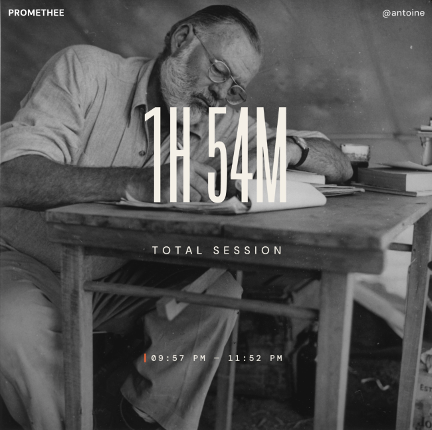
Promethee is a software, and soon an app, which promises to measure your real work, and rank you against other users. Nicolas often describes it as the “Strava of work”. In practice, it detects which software you are working on, without ever seeing what you actually work on. This is important for privacy purposes. It has the ability to detect when you switch from one software to another and calculates a focus score, which translates into experience. Experience is also earned by completing tasks or socializing with other people outside of your work session. And just like for any video game, your experience translates into levels and ranking.
When you launch a work session, a timer appears, laying over your screen. You have a constant reminder of how much time you’ve been working. This is very effective to get into the task. We often fail at working long as our brain tends to believe we started a long time ago when we have been working for only 15 minutes. This is natural. When we first sit down to work, the brain is typically frantic and full of what is coined as “attention residue” by Dr. Leroy (2009), i.e. a cognitive hangover from previous tasks. To clear this residue and get into the task, the brain has to shift gear. Alertness runs on norepinephrine, released from the locus coeruleus, while acetylcholine sharpens what you actually attend to, amplifying the signal of the task in front of you and suppressing the noise around it. Posner and Petersen found the two are separable: drugs acting on acetylcholine affect orienting but not alerting (Petersen & Posner, 2012; Sarter et al., 2005).
A good analogy comes from the sport world in my opinion. When we start working out, we need to warm up. It feels uncomfortable at first. But once warm, we embrace the efforts and while it may feel difficult, it does not feel uncomfortable any longer. This is the promise of Promethee: pushing you down to the point where work is no longer seen as distressing and possibly achieving deep focus.
Promethee also triggers you to stay longer with regular “challenges” pushing you to work another 15 minutes. This again sounds stupid. But it is the same as “can I run the next round slightly faster?” or “can I run another kilometer?” that goes through our brain when we are out running. The science-backed mechanism is the goal-gradient effect: effort accelerates as a goal comes into view. Kivetz, Urminsky & Zheng 2006 found about 20% acceleration toward a reward in a café loyalty study, and a sharp slump immediately after the reward was collected, before re-acceleration. Fair enough, this is consumer loyalty behaviour and not knowledge work. But the sawtooth is the point: each finish line buys you a sprint and charges you a trough. I have come to realise it is also true of 12-week cycles and I must usually take a couple of weeks break in-between two cycles.
Achieving deep focus can also be helped with audio, though the science behind it is often wildly overstated. You will frequently hear productivity gurus claim that listening to 40 Hz audio frequencies directly spikes dopamine and acetylcholine, helping your prefrontal cortex lock into tasks. The reality is much less sensational: the 40 Hz idea stems from fascinating MIT research on clearing amyloid plaques in mice, but the only rigorous randomized trial testing these frequencies on healthy adults found they did absolutely nothing to enhance attention or memory.
Yet, I still use it every single day. Why? Because this proves a lot less distracting than music. Even classical music or jazz, which both have patterns that can, at times, distract me. The brain is indeed a prediction machine. According to the neuroscientific model of "predictive coding," when we listen to music, the brain automatically tries to predict the next note, chord progression, or rhythm.
For audio to aid focus, it has to be predictable enough to stop being interesting.
The acoustic patterns are so repetitive, predictable, and structurally flat that the brain instantly figures out the pattern, gets bored by it, and stops processing it entirely.
With that in mind, Promethee delivers a soundscape that is both relaxing and motivating, but never distracting. When I do not have access to Promethee, I use Endel, an audio app that creates personalized soundscapes to mask distracting noise and match your natural energy levels. I’ve spent over 9,000 minutes over the past three years listening to their AI-generated environments (free 14-day trial here, I earn nothing from it). The real mechanism at play isn't a magical frequency but classical conditioning. When you consistently listen to the same type of ambient audio only when doing deep work, the sound becomes a powerful cognitive trigger. Your brain hears the opening notes and automatically knows it is time to drop the attention residue and focus. I can no longer live without it.
Now, can it really tell who is working hard from who is gaming the system? No, as they do not read the content of your screen or cannot see what you’re doing in front of it. After all, you could very well spend the entire session on your phone, moving your mouse to trick Promethee into believing you’re working hard on your Word document.
Once you’re done with your work session, you can publish your session, adding comments on what you did, what you found difficult, eventually sharing the outcome. This is the equivalent of my WhatsApp group for sport. And why Nicolas calls it the Strava of work. Users can interact with your post, either by showing support or providing advice or sometime even offering their help.
The other social feature, still in its early stages, lies in the concept of the guild. A guild regroups users around a hobby, an interest, or a company (a growing number of start-ups have implemented Promethee at the corporate level). This remains limited to chats for the time being but I would not be surprised, given previous discussions I have had with Nicolas, if it evolves towards something a lot bigger. Think of forums twenty years ago: a space around a predefined activity or hobby, where you could seek support or interact with other aficionados.
To be fully transparent, I do not use Promethee for the ranking or for levelling up (at least for now). I know I cannot compete with freelancers using it through their whole workday and levels are not, for now, bringing anything to the table. Similarly, I find the token-consumption ranking slightly counterproductive. While I am sure many people are using AI the right way, I am also deeply convinced there is a category of users (beyond Promethee’s users) who brag about their token consumption without ever producing anything useful. It is easy to get lost into AI slop.
I use it for what I enjoy in the initial system developed by Nicolas: a relaxing yet virtual room where I am supposed to be working, without any distraction, surrounded by like-minded people. I genuinely look forward each day to spending some time in this app as I know it means I am dedicating quality time towards my objectives.
What it costs
I like being told the version that gets 90% of the benefit for less, so here is mine, honestly.
My Claude Max subscription runs at about £1,200 per year, which is the larger tier subscription but is not required for most people and even less if it is only to run the 12-week year framework. Promethee is free today, though a paid tier is coming. Endel costs me around £60 a year.
Now the honest version. A YouTube playlist replaces Endel. A cheaper Claude tier is fine unless you are using it as heavily as I am. Promethee will have a free version, and a WhatsApp group with three friends already does the part of it that matters most to me.
So the system costs nothing, and the tools cost twelve hundred pounds.
Both are true, and I would rather say it than pretend otherwise. I can afford to test things, which means I have bought a lot of gear I barely used, at prices I would not defend. There is one strange benefit to that: paying a lot for something makes you feel guilty enough to use it, which is not a reason to buy anything, but it is a real effect. The ones I describe at length in this article are the ones I am happy to stand behind. I have deliberately left out the ones I did not find useful, because I had not used them well enough or long enough to give a fair verdict.
Productivity itself has nothing to do with money. Almost everything I have described you can do for free.
When not to do this
The piece so far argues that productivity is seasonal, so here is the season when it is the wrong tool.
I stopped for four months. Between the fifth cycle and the sixth, I ran nothing. I was not in the right frame of mind for it, and I was also being productive without it on things that mattered. That is worth saying plainly, because the productivity genre does not usually say it: the system is at its best when you want to point deliberately at specific objectives while you already have momentum. It brings balance. It is not a requirement for being a functioning adult, thankfully!
I have also skipped individual weeks for illness or intense work in the office. The fix there is not heroics, it is to catch up the following week or to be kinder at the week-six review and adjust the target for the time genuinely lost.
If you are already underwater, the system can help, but for one specific reason: it forces you to choose. This may be the best productivity advice there is: sometimes it is just a matter of prioritising and allowing yourself to put aside less important tasks. The framework I recommend gives you permission to say, out loud, that three or four things matter for the next 12 weeks and everything else does not, and I will not be dealing with it. That is a prioritisation tool, not a productivity tool, and it is the version I would recommend to someone drowning.
And if you are already in control of your priorities and you do not drift from your plan, you do not need 12-week cycles at all. Genuinely, save yourself the Sunday evening.
One more caveat, which a reader will spot before I do. This works partly because of the shape of my life: married, no children, an office job with some autonomy, a home I control. Someone with three kids and shift work will read all of this differently, and they would be right to. When we have children it will change a great deal. I will run fewer objectives and it is fair to say that priorities will have shifted.
But that is the argument for the cascade rather than against it. You do not build a cycle from your ideal life, you build it from the constraints you actually have, pointed in the direction of the life you want. A newborn is a constraint for a year or two, not forever. In five years it is a different set of constraints. The regular review is what keeps the cycle honest about which ones are real right now. There is no single system that fits everyone. It has to be built around your situation, which is why the exercise starts with your vision and not with somebody's template.
The system is often the procrastination
It is important not to fall into the trap of systems. You can spend a great deal of time thinking about systems, schedulers and methods, put all of it in place, and then do very little with it.
Sometimes the best system is to start a task and finish it. As simple as that. There is no point in a thousand systems if they take tens of hours to set up, because you can always optimise a system, and if no task ever begins they are useless.
I know this because I did it a long time ago. I spent weeks building a Notion template to improve my productivity and it proved useless. The problem was structural and I should have seen it immediately: using them meant going into an app, and going into an app is the exact thing that distracts me. Besides, I did not even enjoy using Notion, which I found more complicated than it should have been for basic tasks. To be fair to the tool, it works for a great many people. Nicolas Lacombe built Promethee off the back of a genuinely successful Notion template for students, and I tried his too and gave that up as well. So it is a me problem rather than a Notion problem. But it is the clearest example I have of building the system instead of doing the work.
There is no research construct for what you might call productivity addictiveness, and I went looking. But three findings line up behind the intuition. The big meta-analysis on procrastination, 216 studies and 691 correlations, ranks the predictors: conscientiousness at r = 0.62, self-control at 0.58, distractibility at 0.45, impulsiveness at 0.41. Organisation comes in among the weakest, at 0.36, which suggests that building better organisation is close to addressing the wrong variable. Then there is a study showing that perceived progress on a goal licenses people to go and do something inconsistent with it, and that merely planning to progress is enough to trigger it. And another showing that vividly imagining a desired outcome measurably lowers the physiological energy to pursue it.
Put together: designing the system delivers the feeling of progress that permits you not to do the work. That synthesis is mine rather than a finding, and I would rather label it than dress it up.
Cycle six
I am writing this at the start of a new cycle, which is the honest place to end, because it is designed entirely around the five that came before it.
Sleep is not a tracked key result this time. After five failed attempts at a bedtime percentage, setting a sixth number would be doing the same thing again more loudly. Instead the bet is that a daily mindfulness practice and reinstated reading fix the underlying mechanism indirectly, by making it possible to be asleep by 00:30. I want to be clear that this is the one part of the plan with no evidence behind it. It is new territory, not a proven lever, and it gets reviewed honestly at week six against the recovery data.
Training is no longer tracked at all. Five cycles say it runs itself, it has become a habit. Reviewing it weekly is spending attention where there is no problem, and taking a thing off the scoreboard once it works is the direction of travel rather than a retreat.
The Dantes objective is now scoped so that it contains zero feature work: writing, curating, posting, and a sales number. If the urge to build something new shows up, I will review it carefully: am I trying to distract myself from the more boring work (marketing for me) or am I implementing a genuinely useful feature?
There is a new professional objective, which is to become the specialist my desk needs on a sector I have worked in but never owned. Weekly deep dives on one topic, notes kept, and a monthly session with the colleague I would be taking it over from. It is the first time a career objective has been in a cycle in its own right rather than as a side effect.
And the structural fix, which I think is the real lesson of Cycle 5. Three weekdays run the full architecture. Two are deliberately flexible. Not "allowed to slip", but designed to absorb the late meeting and the dinner that runs long, so that one good evening cannot cascade into a lost week the way it did last time. Weekends are different by design, because social life has a place. Starting conservative on purpose: better to hold a modest rhythm for twelve weeks than set a strict one and miss it by week three.
Whether any of that works, I will know in December.
Be unapologetic
There is a post-it on my desk. It does not have a to-do list on it. It says:
Be unapologetic.
It came out of some coaching, and it is there because I have spent most of my life feeling that I did not quite belong, or was not quite good enough, or that somebody else would do this better. That is not modesty, it is a reflex, and it has cost me things. It is why a newsletter sat unshipped at the top of a plan for seven weeks. It is why I resisted posting about Dantes on LinkedIn for months, and LinkedIn is now one of my biggest sources of traffic. It is why I still find promoting my own work unnatural, and why colleagues telling me they read an article of mine lands the way it does. It is why I paid for access to a room full of entrepreneurs and then barely spoke in it.
Five cycles of written retrospectives say two things that don't sit comfortably together. The method taught me to finish what I start, which is the thing I most needed to learn and had failed to learn on my own for thirty-five years. And it has not moved my bedtime by an hour, yet.
Both are true because of what productivity is. It is a tool, not a way of living. It works on the things you can put on a scoreboard and it does nothing for the things decided at eleven at night by a person who is not looking at the scoreboard. The parts of my life that work best now work because they stopped being objectives and became ordinary. That is the direction of travel: use the machinery to get a thing established, then take it off the board and live.
I complained earlier that the MBA stayed too high level, that there was not enough theory. I have stopped believing my own complaint. The course was built by operators to be actioned, not studied, and asking for more theory before starting is the same move as buying a better app: one more input, one more week, no work done. The theory was never the bottleneck. What is worth paying for is not more of it but the version that is correct, because the loud version usually is not.
It is why Dantes exists: the bad version of anything is free and loud, and the corrected version is usually just as free and much quieter. Take the twelve weeks. Then go and do the work, which no resource will do for you.
Reading list
Everything named above, in the order I would read it. The papers first, then the four books the article leans on.
-
If you read one thing. Harkin and colleagues, Does monitoring goal progress promote goal attainment?, Psychological Bulletin, 2016. 138 randomised trials, just under 20,000 people. The study underneath every weekly review, and honest about the size of what it found.
-
On what kind of goal to set. Williamson and colleagues, The performance and psychological effects of goal setting in sport, International Review of Sport and Exercise Psychology, 2024. Read the effect sizes with their confidence intervals attached, and note that it is all sport.
-
The case for goals, from the people who built it. Locke and Latham's fifty-year retrospective. Dense, but it is the source rather than the summary, and it contains the concession most citations leave out.
-
The case against. Goals Gone Wild. Short, readable, and the finding about people who fall just short of a target will change how you look at your own scorecard.
-
On flexibility. Beshears and colleagues, Management Science 2021. The field experiment showing that paying people only for gym visits in a fixed daily slot produced fewer visits than paying for any visit at all.
-
On working in public. Gollwitzer and colleagues, When Intentions Go Public. Small samples, and it needs a modern replication, but the mechanism is uncomfortable enough to be worth knowing.
-
On procrastination. Piers Steel's 2007 meta-analysis. Long, but it tells you which variables actually move, and organisation is not one of the big ones.
The four books
-
Andrew S. Grove, High Output Management (Vintage, 1983; revised 1995). The two questions the whole article hangs on, from the man who ran Intel. Written for managers, but it reads as a book about how to know whether you are getting anywhere.
-
John Doerr, Measure What Matters (Portfolio, 2018). OKRs as Grove taught them and Google industrialised them. The mechanics are in the first third; the rest is case studies you can skip if you are impatient.
-
Cal Newport, Deep Work (Grand Central, 2016). Where the term comes from. The prescriptions are stricter than most lives allow, which is a reason to read it rather than to follow it.
-
Mihaly Csikszentmihalyi, Flow: The Psychology of Optimal Experience (Harper Perennial Modern Classics; first published 1990). Thirty years of laboratory work on what being absorbed in something actually is. Slower than anything else on this list, and the one that stays with you.
Relevant topics on Dantes
Everything above is a starting point rather than a syllabus. The free resources for each thread of this article live here:
-
Productivity. The 12 Week Year, OKRs, time management, the weekly review.
-
Management and leadership. Grove, Doerr, and running objectives with other people rather than alone.
-
Entrepreneurship. What the MBA was for, without the fee.
-
Marketing. The part I had never looked at seriously, and the one that changed Dantes.
-
Study skills and learning. How to work the way the library used to make you work.
-
Psychology. Flow, attention, motivation, and the research behind all three.
-
Mental health and mindfulness. The practice Cycle 6 is betting on.
-
Fitness and exercise. The objective that finally ran itself.
Go deeper
Test your understanding of productivity
Explain it out loud. An AI tutor listens and asks questions that expose gaps you didn't know you had.