
Prologue: a road in Côte d'Ivoire
In November 2021, UK Export Finance published a short notice about a road in Côte d'Ivoire. To be more precise, two roads, to be built by Colas UK. The 133 km trunk road between Agnibilékrou and Bondoukou, paved but in poor condition, and the 33 km stretch from Agnibilékrou to Takikro, which was still a dirt track. On top of these two roads, four bridges, over the N'Zo, the Sassandra, the Comoé and the Black Volta. The financing was a £100 million buyer credit backed by the British export credit agency (or ECA for short), UKEF, and the financing bank was Société Générale.
I know that deal well, having worked on it. I guess I just doxxed myself.
It is not a glamorous asset. A road with no tolls generates no revenue for anyone. It makes it safer and faster to move goods and people between regions, which is exactly why a government wants it, and exactly why nobody else will pay for it: it belongs to everyone and nobody at the same time. One way or another, the state has to fund it.
It is however important to put the numbers in context. Côte d'Ivoire's GDP was $72.79bn in 2021. In 2026, the budget for road projects of the Ministry of Equipment and Road Maintenance (Ministère de l'Équipement et de l'Entretien Routier) is FCFA 734.4bn, the equivalent of about $1.26bn. A single project of £100m is a large piece of that, for one road, in one region, in one year of a multi-year build.
So how do you pay for it? On paper, a government has at least five options. It can tap the bond markets. It can pay straight out of the budget. It can borrow from local or regional banks. It can go to development finance institutions like the World Bank or the African Development Bank, if eligible. Or it can raise long-term structured financing, usually with the backing of an export credit agency.
This article is about how a country makes that choice. And because a road is an abstract thing to most people, I will use a public hospital instead. I’ve financed a few of them too. In particular, a few years ago, I worked on the financing of three of them in Oman. We will come back to that one, because it nearly went wrong before the first brick was laid.
Part I. The asset
What a hospital actually is, financially
When people picture a hospital, they picture a building. In practice, however, a hospital is three or four different projects that happen to share an address.
There is the shell: foundations, structure, roof, the civil works that any large construction contractor can deliver. There are the building services, what the industry calls MEP for mechanical, electrical and plumbing, and in a hospital they are far more complex than in an office. Operating theatres need specific air-change rates. Medical gases, oxygen, vacuum, nitrous oxide, run through dedicated copper networks to every bed. Then there is the biomedical equipment: imaging, laboratory, sterilisation, patient monitoring. And increasingly the hospital information systems, the electronic patient records that tie the whole thing together.
Each of those requires a different expertise and runs on a different timeline. Civil contractors build the shell. MEP specialists handle the utilities. Biomedical vendors handle the sensitive clinical devices, and their fit-out typically trails the end of construction by months.
You can split these into separate packages and tender each one. Or you can hand the whole thing to a single contractor, very often under an EPC contract, who then relies on sub-suppliers for each specialty. That is what we call a turnkey approach: one provider manages design, construction, medical equipment integration and the information systems under a single contract, so the government deals with one counterparty instead of multiple.
For a ministry with limited project management capacity, turnkey is often the only realistic option. And as we will see, it is also the structure that export finance likes best.
Financially, a hospital is three or four different projects that happen to share an address.
Three real hospitals
I had planned to use a made-up example, for confidentiality purposes. But it turns out that public data is good enough to use the real thing, so here are three hospital projects, a couple financed by competitors of mine, all documented in public sources.
Côte d'Ivoire, six hospitals, 2021. Six regional and general hospitals, mostly in the north of the country: Bouaké, Boundiali, Katiola, Kouto, Minignan and Ouangolodougou. The contractor was NMS Infrastructure, a UK developer, under an export contract with the Ministry of Health and Public Hygiene. Total project: €326m. UKEF provided €241m in two tranches, part buyer credit and part direct lending, and MUFG provided a €52m commercial loan. Don’t be put off by the technical terms: we will come back to them over the course of the article. A government adviser said at the time that UKEF's ability to lend directly was key to securing the deal.
Ghana, Koforidua, 2020. The Eastern Regional Hospital in Koforidua, phase one, 285 beds out of a planned 600. A €70m construction contract with a UK joint venture of Tyllium and Ellipse Projects. The financing: €60.2m from UKEF over 13 years, plus a €17.6m commercial loan from Standard Chartered over 5 years. Keep this one in mind. It comes back at the end, and not in a good way.
Oman, three hospitals, 2019. Salalah, Suwaiq and Khasab, with intensive care, emergency and specialist baby care, all built to UK NHS standards at the Sultanate's request. The contractor, International Hospitals Group, delivered a full design, construction and services package, including emergency power, maintenance facilities and access roads. Total financing of $873.7m, with slightly over £500m backed by UKEF buyer credit and direct lending facilities over a tenor of 14 years, the balance being financed through what we call tied commercial loans over 5 years. It was the first time the Omani government tapped international finance this way, and the trade press named it one of the best deals of 2019. I worked on that financing, alongside some of my competitors.
The Oman deal shows something the headline numbers hide. One of IHG's suppliers, a family firm called Lawton Tubes, later published the details of its own slice: 260,000 metres of copper tubing for plumbing and medical gas, more than 317,000 fittings, an order worth about £1.9m. That is how a large export contract actually works. The headline exporter is the tip of a supply chain of dozens of smaller firms, and every one of them is paid through the lead contractor. Keep that in mind too: it is the whole reason export credit agencies exist, and we will get there in Part IV.
What these projects almost never disclose is the split: how much went on concrete, how much on scanners, how much was spent locally. That split matters a great deal for the financing, as we will see in Part IV, but it stays between the contractor, the ministry and (sometimes) the banks. And for obvious reasons, I will not be able to provide further information on that: that level of detail would not add much anyway.
Matching the money to the building
Here is the one principle the rest of this article hangs on.
When you buy a house, you do not pay for it with a credit card. Not because the credit card would get declined, if it was even accepted (most probably not), but because you would have to repay the whole thing within weeks, from a salary that arrives monthly, for an asset you will live in for 30 years. Like everyone else, you take a mortgage over 20 or 25 years, and the repayments roughly track the years you get out of the house. Even wealthy people tend to not buy real estate with 100% cash: this is usually a suboptimal strategy.
A country works the same way. A hospital will serve patients for at least thirty years. Financing it with money that must be repaid in three years is the credit-card mistake at national scale. It forces the government to find the full cost from a few years of budget, crowding out everything else, for an asset whose benefits arrive over decades.
You will most likely argue that the Ivorian ministry had a massive budget of over a billion. Why couldn't it use part of it to pay for that road? Well, again, it is not the only expense it has to make this year, so it may not be the best use of money to put such a large amount towards a single project that could be financed over a longer term. Therefore, unless you are in the comfortable position of running a budget surplus, and nowadays very few countries have that luxury, it generally makes little sense to pay cash for such long-term assets. And even then, it may still make more sense to borrow for at least part of it.
The question is therefore never just "how much does it cost?". It is "can we find money of the right shape?" Long enough, cheap enough, and in a form the country can actually service. This is the important bit: can it afford it over the long term? Otherwise, it may indeed make more sense to fund it in cash while it has some, but this also means prioritising this project over some others. In an ideal world, this would be handled that way. But this is not realistic: one hospital being paid cash here means some maintenance being postponed or another health facility being cancelled as there is no money for a few years to fund it.
And for an emerging market, there is a second squeeze: the currency. The contractor will usually want to be paid in euros or dollars, and the lenders will lend in the same currency. Why? Because as a lender, you do not want to add foreign exchange risk to the panel of risks you are already trying to mitigate. A currency mismatch between the financing and the contract could leave the financing short of what is needed to pay for the contract if the exchange rate goes in the wrong direction, meaning that the borrower would have to pay the balance in cash whenever this happens. This brings uncertainty to all parties.
The hospital, meanwhile, earns nothing in hard currency. A public hospital run by the Ministry of Health earns little or nothing at all, and whatever fees it collects are in local currency. The running costs, staff, drugs, maintenance, come out of the Ministry of Health budget year after year. And the debt service comes out of the national budget, in dollars or euros, for fifteen years.
This adds a new question for a country like Côte d'Ivoire: it is not only whether it can afford a hospital. It is also whether it can carry another fifteen years of hard-currency debt service for an asset that will never pay a cent of it back. Spoiler: Côte d'Ivoire is actually lucky. The country is the world’s largest producer of cocoa beans, with 35 to 40% of the world’s annual production. This is an extraordinary source of hard currency, as cocoa traders and other international agri-companies are buying cocoa beans in US dollars or euros.
Worth noting as well: Côte d'Ivoire has an advantage here that Ghana, for instance, does not. Its currency, the CFA franc, is pegged to the euro. Euro debt is still foreign debt, but at least the exchange rate does not move against you every year.
None of this is specific to hospitals. Whenever you lend to a sovereign in export finance, you are usually looking at assets that do not generate cash: a road between two cities with no tolls, defence equipment (a Typhoon fighter jet is not going to generate any cash flow), a public railway. A railway is more interesting, because passengers pay a fare, but on public infrastructure the fare is likely to be heavily subsidised so that it benefits the wider population, and it will not repay the loan within a timeframe that makes economic sense for lenders. Even in the UK, an NHS hospital is unlikely to generate enough cash to repay itself. Some hospitals take private patients and earn a little, and the Ministry of Health gives them an operating budget, but that budget rarely includes debt service, especially since the loan usually sits with the Ministry of Finance. That is the gap export finance bridges: projects that have to be carried by the sovereign's budget rather than financed on their own cash flows.
Financing a hospital with money that must be repaid in three years is the credit-card mistake at national scale.
Part II. How rich countries do it
Three doors: budget, bonds, PPP
A developed country with a new hospital to build has three doors, and all of them are wide open.
The budget. The simplest one. The health ministry has a capital budget, the hospital goes into it, and it gets paid over the years of construction from taxes. For a large economy, a $200m hospital is a rounding error. But again, paying it in cash might not be the most economically rational decision.
The bond market. If the budget is tight, the treasury borrows. The UK, France or Germany can issue bonds of 10, 20, 30 years or more, in their own currency, at whatever rates the market sets for some of the most liquid government debt in the world. The money is fungible: nobody asks which hospital it paid for. This used to be cheap. Very cheap, to the point that it turned negative for a few years, as illustrated by the German 10-year Bund:
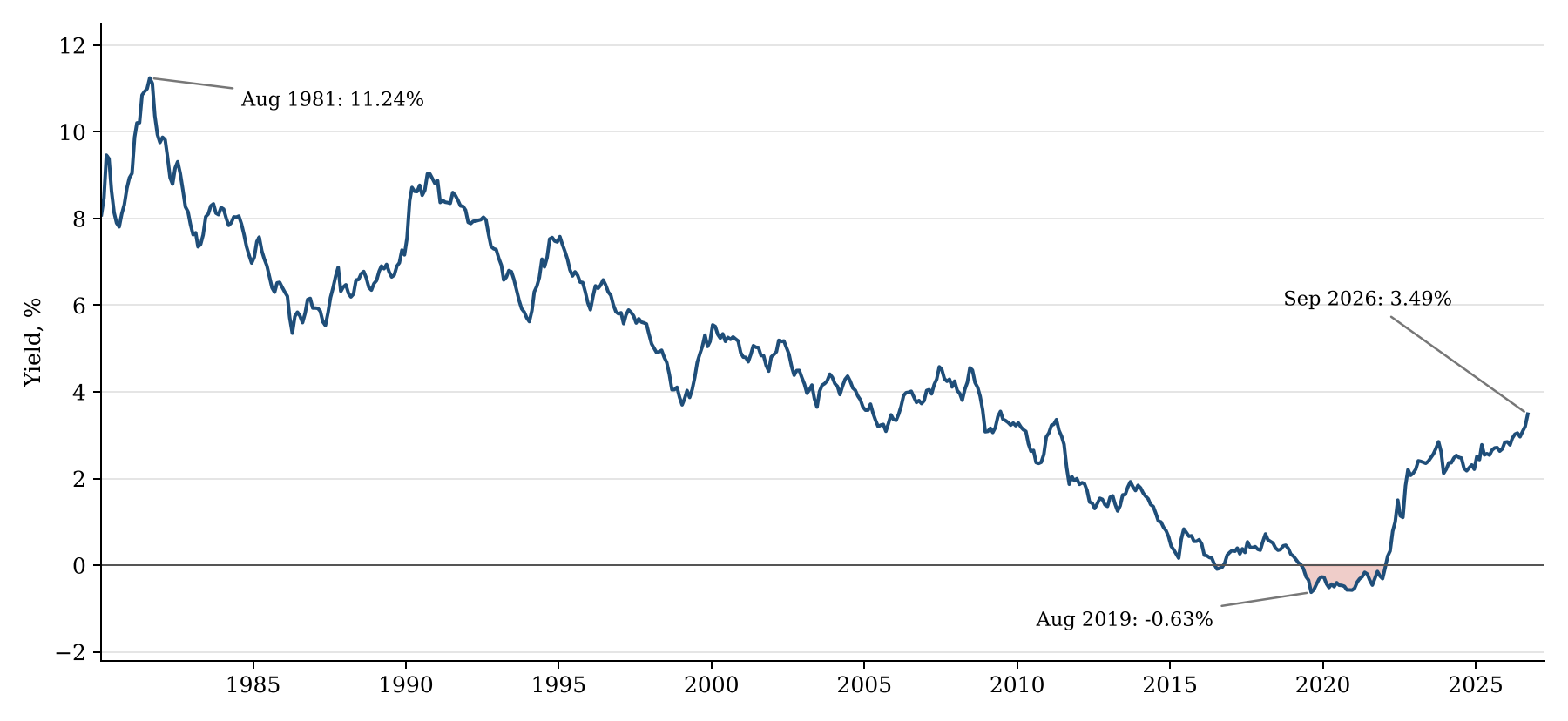
German 10-year government bond yield, monthly average, 1980–2026. Source: Banque de France (Webstat).
Now, if you follow the news, rates have increased sharply over the past few months. In July 2026, the French 10-year yield reached 3.90%, its highest level since 2009, and it was hovering around 4% in August, close to its 2008 highs, the year of the financial crisis. It is getting worrying, but this is not the topic of this article.
The PPP. A public-private partnership is a long-term contract between a government agency and a private company to fund, design, build, operate and maintain an infrastructure that the public uses. The private company takes on significant construction and operational risk, and raises the financing, in exchange for government-backed payments, user fees or rent over the life of the agreement. The government gets a hospital without paying for it upfront. It pays for it in instalments, for decades.
PPPs are quite frequent in developed countries, and hospitals are a classic use case. They are also where things can go spectacularly wrong. I insist on “can”: this is not a rule (thankfully!).
Nya Karolinska Solna, in Stockholm, is one of Europe's largest health infrastructure PPPs. The original budget was SEK 14bn, about $1.8bn. By 2018, the estimated cost had passed SEK 60bn, about $7.5bn, over the life of a 22-year contract with the private partners. Swedish newspapers reported charges of up to SEK 1.2m, about $150,000, to replace an ordinary door. Sweden's finance minister called it "the world's most expensive hospital". Now, can all these issues be linked to the PPP structure? Not so sure: we’ve seen similar overcharging issues in France on public hospitals procured the conventional way, maybe not to that extent I must concede.
The UK went further than anyone with its own version, the Private Finance Initiative. Under PFI, the private sector raises the upfront debt and equity through a special purpose vehicle (a company incorporated for the sole purpose of owning and operating that asset), builds the asset, maintains it, and the public sector pays an annual charge for decades. By January 2018 the National Audit Office counted over 700 PFI and PF2 deals with a capital value of around £60bn. Annual charges were £10.3bn in 2016-17, and future charges of £199bn were already committed, running into the 2040s, even if no new deal was ever signed.
That same month, Carillion, one of the largest PFI contractors, went into liquidation, with two PFI hospitals still under construction: the Royal Liverpool University Hospital and the Midland Metropolitan Hospital. The government terminated both PFI contracts and moved them to public financing. The National Audit Office later found that private shareholders, investors, insurers and Carillion lost at least £603m across the two, and forecast that Liverpool would open more than five years late. In October 2018, the Chancellor announced that the government would no longer use PFI for new projects. Keep this example in mind: Carillion comes back later.
The lesson is not that PPPs are bad. It is that a PPP is a 20 to 30-year contract, and every badly priced clause in it compounds for 20 to 30 years.
Part III. When the doors are narrow
Now take the same hospital to Côte d'Ivoire, or Ghana.
The three doors are still there. They are just much narrower, and a fourth and fifth door appear: the development banks, and export finance. The latter also exists for developed countries, it is just not as attractive.
Why PPP struggles
Start with the PPP, because it is the one that looks most attractive on paper and is the hardest to deliver.
A PPP only works if three things are in place. First, a legal framework that is bankable: amongst others, clear rules on how the contract is awarded, what happens on termination, how disputes are resolved and whether the government's payment obligations are enforceable. The World Bank has a whole resource centre on this, and many countries simply do not have it, or have it on paper and not in practice. The absence of a strong legal framework around PPP is a major red flag for any financier.
Second, a credible, financially sound private company willing to take on 20 or 30 years of operational risk in that country. There are not many.
Third, a safe revenue stream the private partner can rely on. A toll road has one, though usually subject to traffic (which can be mitigated through other mechanisms). A road with no tolls does not. And a hospital that will be managed and operated directly by the Ministry of Health does not either: the only payer is the government, so you are back to the government's credit, with a more complicated contract on top. Over such a long duration, the credit risk is material. In the absence of strong mitigants to that credit risk, it is unlikely that a private company will take the risk of engaging in a PPP.
That does not mean a PPP is impossible in such a country. An ECA can back the financing of a PPP, and the lenders are then covered not only while the hospital is built, but through the operational phase too. But only the lenders: they are the ones providing the financing. The ECA covers the debt, not the government's payments to the operating company. If the government stops paying, the lenders still get their debt service from the ECA, or are prepaid as part of a claim, but the operator does not get paid for running the hospital. For twenty years or more, the private company faces a credit risk on a weak sovereign, its only payer, together with a heightened operational risk in a market it may not know well. A PPP alone is rarely the ideal answer in such a jurisdiction.
Lesotho is the case everyone in the sector knows. In 2008 the government signed a PPP with a consortium led by the South African group Netcare to design, build, part-finance and operate the 425-bed Queen 'Mamohato Memorial Hospital in Maseru. The World Bank, whose IFC advised the government, rated the outcome "moderately satisfactory". The hospital was delivered on time and on budget, and its clinical quality is high by regional standards.
But the annual payment to the private partner rose 68% through indexation between 2008/09 and 2015/16. By 2015/16 the consortium was receiving about 60% of everything the Ministry of Health paid to healthcare providers in the country. Same hospital, two readings. That is PPP in a small economy in one sentence.
A hospital run directly by the Ministry of Health has only one payer: the government. Call it a PPP if you like, you are still borrowing against the state.
Why a Eurobond is not the answer
The second door is the bond market. Côte d'Ivoire has been there many times. In March 2025 it issued $1.75bn of amortising notes due 2036 with an 8.075% coupon, alongside a XOF 220bn tranche due 2028 at 6.875%, the first international bond ever issued in CFA francs. Then, why not simply issue another bond for the hospital?
Five reasons, in no particular order.
First, depth. A frontier sovereign does not have a bottomless market. Investors have a limited appetite for each issuer, and every bond spent on one project is capacity that is not available for something else, including the general budget. You need to be prudent in how you use it.
Second, the coupon, or cost of the debt. 8.075% in dollars is expensive money, and the coupon is fixed for the life of the bond. It is difficult to compare with the equivalent floating-rate loan without access to a Bloomberg terminal, but we will attempt a comparison a bit later.
Third, a technical concept called cost of carry. This is the one people underestimate, because it requires a bit of abstraction. Upon issuance of a bond, all the proceeds are made available to the issuer, usually on day one. The hospital is not built on day one, and not even paid in full upfront. It is built over three years, and the contractor is paid in milestones, i.e. over time. With a bond, the country pays the full coupon on money that sits in an account waiting to be spent. This is a waste of money, unless you invest that money at a higher rate than what it costs. A loan works differently: it is drawn step by step, in our particular case, as the contractor invoices, and the undrawn amount only carries a small commitment fee. It is therefore cheaper during the construction period. Besides, a loan usually amortises from the end of construction, which a bond does not.
Fourth, the tenor. Investors in frontier markets may not have appetite for long-term bonds. Therefore, bond maturities tend to be shorter than the life of the asset. A 2036 bond issued in 2025 is an 11-year instrument. A hospital will operate over a much longer tenor, to which you also need to add the construction period.
Fifth, the contractor. In some frontier markets, an international contractor will not start work on the strength of a bond. If the government issues a Eurobond, the contractor has no certainty that the proceeds will be used to pay it: the money lands at the Treasury, and the Treasury has many other bills. With ECA financing, the loan is usually disbursed directly to the contractor, even though it is not a party to the loan, and the use of proceeds is well-defined, meaning the loan cannot be used to pay for something else. More on that in Part IV.
To make the carry point concrete, let me use a real loan, with every term published by the Parliament of Ghana, in a Finance Committee report of 16 December 2019.
In December 2019, Ghana's parliament approved the financing of phase I of the Tema–Aflao road: 17 km of expressway, service roads and interchanges on the coastal highway that runs from Abidjan to Lagos. The contractor was BHM, a UK civil engineering firm. The report of the parliament's Finance Committee lists the terms of both loans:
-
A UKEF-guaranteed facility of $93m, including the 13% UKEF premium, arranged by JP Morgan. 6-month Libor + 0.80%. A commitment fee of 40% of the margin, i.e. 0.32% a year. An arrangement fee of 0.75% flat. An agency fee of $10,000 a year. 3 years' grace, then 10 years of repayment: 13 years in total, repaid in semi-annual instalments.
-
A tied commercial facility of $25m, from Mauritius Commercial Bank and Barclays Bank of Ghana. 6-month Libor + 5.00%. An arrangement fee of 1.25% flat. 1 year's grace, then 4 years of repayment.
Together, in the committee's words, a "100% financial solution": Ghana did not have to put in a single dollar of counterpart funding. Take the premium out, and that is $105.9m of actual construction money, $80.9m under the UKEF facility and $25m under the tied loan, spent over the three years of the build.
A margin of 0.80% is on the cheap end, but Ghana was, at the time, a strong credit, all things being relative, much like Côte d'Ivoire today. We will come back to why ECA-backed loans achieve such competitive pricing.
Option A, a Eurobond. The same $105.9m raised on day one at 8.075%, the Côte d'Ivoire March 2025 coupon, with a final maturity after 11 years. That is about $8.6m of coupon a year from day one, before a single kilometre is paved. At maturity, the full $105.9m is due for repayment, unless the issuer rolls it over, i.e. reissues at the prevailing market rate (which could be cheaper or more expensive).
Option B, the Ghana package. The two facilities above, drawn as the contractor is paid. To compare apples with apples, I priced everything in dollars at the same reference rate: SOFR, which replaced Libor in 2023, at its March 2025 average of 4.33%, held flat.
The comparison is the all-in cost of each dollar actually spent on the project, everything included: interest, margin, fees and premium.
| Structure | All-in cost per dollar spent |
|---|---|
| Eurobond, idle cash earning nothing | 10.4% |
| Eurobond, idle cash earning SOFR (4.33%) | 9.4% |
| Tied commercial facility alone (uncovered, 5 years) | 10.7% |
| Ghana's package, both facilities together | 8.9% |
| UKEF facility alone (13 years) | 8.7% |
| UKEF facility, if there were no premium | 5.6% |
Three things jump out.
First, the carry turns an 8.075% bond into something between 9.4% and 10.4%, depending on what the treasury does with the cash while it waits.
Second, the ECA premium is not small. 13% upfront adds about three percentage points a year to the UKEF facility. That is the price of the cover, and we will come back to it.
Third, even with that premium, the ECA-backed package comes out cheaper than the bond, and most of it is repaid over 10 years after construction rather than from day one. The one piece that costs as much as the bond is the tied commercial loan: the part the cover does not reach.
Of course, this is a simplification. I held SOFR flat for 16 years, which nobody would do in a real model, and I compared floating loans with a fixed bond. A real treasury would swap the loans to fixed, or compare against the bond's yield rather than its coupon. I also had to assume the drawdown profile and the amortisation schedule, which the documents do not give. But the shape of the result does not change: on a project that is spent over three years, the bond pays interest on money that is not working yet. We will come back to this loan in Part VI, to see who actually earns what.
That does not make bonds a bad option. If the all-in cost of the bond, carry included, comes out below the equivalent ECA financing, use the bond. And bonds give you something ECA financing never will: flexibility on the use of proceeds. A Eurobond can fund the general budget. An ECA loan is tied to a specific contract with a specific exporter. You must have a well-defined use of proceeds, it cannot be "general purposes".
Which is exactly the point. For a frontier sovereign with limited depth, it is worth paying a bit more for an ECA loan on a dedicated project, to keep the bond market available for the things only the bond market can fund.
On a project that is spent over three years, the bond pays interest on money that is not working yet.
Why the cheapest money runs out
There is a third source of money that beats both bonds and ECAs on price: the development banks.
The World Bank's concessional arm, IDA, lends to the poorest countries at very low rates over very long periods. Both Côte d'Ivoire and Ghana are IDA-eligible and borrow on "blend" terms, a mix of concessional and less concessional credit. Côte d'Ivoire is also considered creditworthy enough for some borrowing from IBRD, the World Bank's standard, market-priced window. The African Development Bank plays a similar role.
The catch is that this money is rationed by allocation, not by price. Each country gets an envelope, and the government has to decide where to spend it across roads, schools, water, energy and health. You cannot simply ask for more because the price is attractive. Most countries stack: concessional money where they can get it, and ECA debt for the rest.
Some countries push hard for it anyway. Kenya, for instance, usually asks for a concessional bit, even for ECA financing. From a lender's perspective, that is difficult to deliver: a bank cannot provide concessional financing. It is for the borrower to find it, and it comes from pockets of liquidity where banks have limited visibility, often DFIs, sometimes diplomatic relationships. A lot of Middle Eastern countries, for example, have special funds that can provide concessional money. Lenders can offer guidance and suggest ideas, but they have very little leverage to push one file over another and selection criteria are often not transparent anyway. That is where some deals fail to get financed: the borrower has expectations that cannot be matched. ECA finance is a great tool, but it cannot do everything.
ECA finance is a great tool, but it cannot do everything.
And then there is the IMF.
A country under an IMF programme cannot simply borrow as it likes. Any new debt has to fit the limits agreed with the Fund, and that includes ECA financing. In practice, a project must be strategic, urgent and offer excellent value for money for its financing to get through. And even then, the IMF may not approve it if the pre-agreed envelope has already been used, or if the terms and conditions of the loan are deemed unsustainable, or simply not competitive enough.
Ghana shows how tight this gets. Under its Extended Credit Facility, the government capped new non-concessional borrowing at $66.2m in present value terms for 2023. For 2026, the limit is $70m in present value terms for the central government, all covered entities and state-owned enterprises combined. And all external debt financing must go exclusively to infrastructure and self-financing projects. For a whole country, $70m is less than the cost of one regional hospital.
This is not new, by the way. When Ghana's parliament approved the Koforidua hospital loan in 2019, the memorandum noted that it was already on a list of projects cleared for non-concessional borrowing under the IMF programme of the time.
For a whole country, $70m of new non-concessional borrowing a year is less than the cost of one regional hospital.
Part IV. Export finance
What an export credit agency is, and why it exists
Before going further, a word on the institution at the centre of all this, because it is the one most people have never heard of.
An export credit agency, an ECA, is a public institution whose job is to help its own country's companies sell abroad. Most exporting countries have one. In the UK it is UK Export Finance, a government department. In France, Bpifrance Assurance Export, acting on behalf of the French state. In Italy, SACE. In Germany, the federal government's export credit guarantees are managed by Euler Hermes. In the US, the Export-Import Bank. The British one claims to be the oldest: it was set up in 1919, as the world's first export credit agency.
Why does a country need one? Three reasons.
First, to sell more abroad. That is the mandate, written in black and white. UKEF's mission is "to advance prosperity by ensuring no viable UK export fails for lack of finance or insurance". Go back to the Oman hospitals. The headline exporter was IHG, but behind it sat a supply chain of UK firms, from the copper pipe maker to the specialist suppliers of medical equipment. On an earlier deal for seven district hospitals in Ghana, built by NMS, UKEF counted about 50 UK SMEs in the consortium. Fifty small British companies working on one project, in one country, because one financing was in place. For an ECA, that is a massive achievement. UKEF says its support in 2024-25 alone, £14.5bn of loans, guarantees and insurance, supported up to 70,000 UK jobs.
That is also why an ECA cares so much about where things are actually made. What it does not want is a post box: a French-incorporated company that buys everything from China and sells it on to another French company, which then benefits from a Bpifrance loan. Technically, the goods were manufactured outside France and barely transited through it. It is a pure trader, and it does nothing for France's trade balance. An ECA will investigate that. What it wants is more production of goods and services from its own country: jobs created or safeguarded at home, and more exports than imports. That is why an ECA exists, and that is why it puts so much focus on content.
Second, because the private market alone will not do it. When a bank considers lending $200m to Côte d'Ivoire for 15 years, it is pure credit risk, basically. It is the same with a financially-weak corporate, whether a small company or a large one that already carries a lot of debt: a bank may not be willing to lend a large amount for a long period of time. Without some form of support, many perfectly sound export contracts would simply not find a lender, or only on terms the buyer cannot afford. The ECA fills that gap.
Third, because everyone else has one. If a French contractor bids with a 15-year, ECA-backed loan and the British contractor bids with a 5-year bank loan, the French contractor wins, whatever the quality of the hospital. So every exporting country has built the same tool. To stop that competition from turning into a race to subsidise, the main ECA countries signed up in 1978 to a common rulebook, the OECD Arrangement on Officially Supported Export Credits, which we will come back to when we talk about the strings. China is not part of it, which matters later too.
Fifty small British companies working on one project, in one country, because one financing was in place.
Now the part most people get wrong when they read the news. I have seen it so many times on social media: "the UK government is giving money to Ghana when our own budget is constrained", outrage in the comments. They simply assume that the ECA is giving away taxpayers' money for free to a foreign government. Rest assured: it is not. ECA support either takes the form of a cover, like an insurance, or of a loan. If it is a cover, a premium is paid to the ECA to reward the risk, and as we will see, it is a hefty one. If it is a loan, the ECA charges interest, just like any other financier would. UKEF states that it operates at no net cost to the taxpayer. It is not aid: it is a business, run by the state, to support its exporters. This does not mean an ECA is a for-profit organization. It primarily aims at not losing any money while ensuring that no export fails due to lack of support.
Worth noting, ECA mandates have widened in recent years. Many ECAs now go beyond exports and provide cover for projects that help their country secure supply of critical minerals, or make financing solutions available directly to their exporters to help them scale up and export more. Germany's untied loan guarantees for the supply of critical minerals to its industrial, energy, and technology sectors are one example: Trafigura, one of the largest commodity trading houses in the world, signed a $1.1bn loan backed by Euler Hermes, on behalf of the German state. It is the same idea seen from another side: the state does not build the asset, it removes the financing bottleneck that stops private capital from doing so.
Governments have been investigating and sometimes even proceeding with new ways to bridge financing gaps for large and strategic infrastructure projects and critical mineral supply chains, but not only. We’ve seen it in the US, where in June 2026 the Department of Energy issued conditional loan commitments of up to $17.5bn to finance the purchase of long-lead time items needed to rebuild America’s commercial nuclear supply chain. The purpose of this move is to reduce the timeline usually required on nuclear projects, while lowering the construction costs.
Another good example, again pertaining to the nuclear sector, can be found on the other side of the Atlantic: the involvement of the UK’s National Wealth Fund (NWF) in the financing of the new nuclear powerplant Sizewell C with a term loan of up to £36.6bn! This latter example is even more interesting as NWF’s loan sits alongside £5bn of lending guaranteed by the French export credit agency, Bpifrance Assurance Export. NWF’s rationale to lend to the project is explained very clearly on their own website: “The construction of Sizewell C will also deliver significant regional economic benefits to the area, supporting an estimated 10,000 jobs during the peak construction phase and thousands more in the nationwide supply chain.”
How the deal is born
Most people assume a country decides to build a hospital, then goes looking for money. In export finance it often works the other way round: the money arrives attached to the builder.
It starts with a simple constraint. In most frontier markets, no local contractor can build and fully equip a large hospital alone. There is a strong reliance on international partners, for the design, the MEP, the medical equipment. Accordingly, the government goes to the international market, either through a tender or through direct negotiation with a single contractor, what francophone ministries call gré-à-gré.
And even where a local contractor is large enough to build such a project, globalisation means it is very likely that some components, or part of the project, will be produced, manufactured or designed outside the country. It is the same in developed countries, so it has nothing to do with being a frontier market: this is globalisation at play. Export finance can step in as long as there is a minimum content from a given country. If an Ivorian contractor were to build the hospital with at least 20% of UK content, the project could still be eligible for cover from UK Export Finance.
A proper international tender is a document in its own right. The government issues a request for bids detailing the project and the core terms: how many beds, the location or possible locations, the type of equipment, the facilities required (laboratories, an oncology ward, emergencies, a maternity unit, etc.), whether it is a new build or a brownfield upgrade of an existing site, and the standard expected.
It also specifies what bidders must submit by the deadline. A commercial offer only, a commercial and technical offer, or a commercial, technical and financing offer. It states the type of contract: an integrated turnkey contract such as an EPC, lump sum or cost plus. And it states whether the contractor must also deliver the design, or only build and equip from an existing one, which is the difference between design-build and design-bid-build. There can be a single round or many rounds. In any case, there will be further negotiations, even well after a preferred bidder has been selected, and they carry on until the signature of the commercial contract between the buyer and the seller.
The financing can be discussed at different stages of that process. When a tender explicitly requires the bidders to submit a financing offer alongside their commercial and technical offers, it happens very early. Banks may even support different bidders for the same tendered project, subject to confidentiality rules.
You may wonder why the bidders would be asked to bring in a financing offer. This is a good question. It serves a few purposes.
First, it helps buyers and borrowers with limited experience of international financing to reach international lenders through the bidders. They benefit from the banking network of these bidders.
Second, such tenders are often issued by the ministry in charge of that sector, for instance the Ministry of Health for a hospital. That ministry will need approval from higher authorities: the parliament, the president, or the Ministry of Finance, which will be the ultimate borrower or guarantor in most instances. By requesting financing offers early on, it can ease that step by demonstrating that the project can be financed, at an acceptable cost. This is much smoother than presenting a project with no source of funding identified.
Third, it creates competitive tension around the financing as early as possible. Each proposal will be reviewed from every angle, which means that an uncompetitive financing offer could drag down a commercially and technically sound bid. It is therefore in the best interest of the bidder to push its banks to put forward a very competitive proposal from an early stage.
Financing offers can also be requested at a later stage. They are sometimes subject to their own tender, run by the borrower (usually the Ministry of Finance) or by the buyer under the supervision of the borrower. When Côte d'Ivoire financed its six hospitals in 2021, for instance, an adviser, GKB Ventures, ran a tender among banks on the government's behalf, and the Japanese bank MUFG came out as preferred lender for the commercial loan. Or the financing can be negotiated bilaterally: this is more the case when the contractor has brought forward a very competitive financing offer covering the entire project amount, or when a bank has sent an unsolicited offer early on upon hearing about an upcoming project. For larger projects, it is more standard to have a few banks teaming up to finance the deal.
Either way, this is where export finance enters. A serious international contractor bidding for a hospital in Côte d'Ivoire will not turn up with a price alone. It will have already been to its relationship banks and to its export credit agency (often through the intermediary of its banks), and it will turn up with a package: here is the hospital, here is how it will be built, and here is a 15-year loan to pay for it.
At this stage, the ECAs compete with each other. UK Export Finance, Bpifrance, SACE, Euler Hermes and their peers all want their own exporter to win. They compete on two things in particular: how flexible they are on national content, meaning how much of the contract must be sourced from their own country, and how much cover they are willing to put on the table. Even though they are not necessarily lending the money, each ECA has its own risk appetite framework that may limit its capacity to provide cover to a given project, especially if that project is very large or located in a country where its limit is nearly used up, either because of an already high exposure from prior projects in that country, or because of a lack of credit appetite for that specific jurisdiction (usually riskier countries).
Where it gets even more interesting is that ECAs sometimes compete to get the exporter, or the lead contractor, to source from their own country. Many large corporates have subsidiaries in various places and sourcing capacity all over the world. They will usually pick their sub-suppliers on price (after all, it needs to make economic sense for the project, especially when you are trying to fit it within a predefined budget) and on specs (again, it must meet whatever the design requires). But it often happens that they receive similar proposals from suppliers based in different countries, and each ECA will push for its national champion to be selected.
This is especially true when the contractor is an orchestrator rather than a manufacturer. A company like Rolls-Royce, with massive production facilities in the UK, will go straight to UK Export Finance. An EPC contractor with no manufacturing capability of its own is different: it often handles the design, which counts as content from its home country (or from whichever office it has designated in charge of that workstream), and then looks for who can supply the rest. If it finds that Siemens, for instance, can supply the medical equipment to the right specs at the right price, it may meet the minimum German content and be able to approach Euler Hermes.
When a bank is approached at that stage, the contractor often does not yet know exactly where its procurement will come from. It knows it can source from this country, that country and that one. Our role is then to discuss with each ECA what minimum content it would require for this project, whether it has appetite for the country, and how quickly it can move. We draft indicative offers, not for the ECAs but for the Ministry of Finance: one backed by Euler Hermes, one by UK Export Finance, one by Bpifrance. They do not all offer the same cover or carry the same rating, so the pricing differs slightly, and sometimes that is what decides. The borrower may say: "The UK Export Finance offer is better, because it can add direct lending, it is willing to support a higher amount, and the overall pricing is cheaper." From then on, the exporter must find a way to source enough UK content to meet that ECA's requirement and ensure it will come along with its support.
This is not that simple though. If the project ends up being 10% more expensive due to British suppliers being more expensive than, let’s say, German alternatives, but it saves only 2% on the overall financing costs, would it still be the right choice? All these considerations must be accounted for during the selection process. Such contracts and their related financing take months if not years to be finalized.
Besides, the minimum is not a formal entitlement. UK Export Finance's floor is 20% UK content, and Bpifrance's is also 20% French content, but an ECA may ask for more on a given project, for instance if it feels it has already supported a lot in that country without enough production from home. Like a bank, an ECA has an envelope per country. When that envelope gets tight, it keeps it for the projects with the most value added from its own country, with also in mind how strategic that project is for the destination country. That is how it stays selective.
For larger projects, ECAs can also team up, provided again that there is enough supply from their respective countries. This can take the form of several tranches, each backed by a different ECA, or of reinsurance from one ECA to another. Reinsurance usually happens in the background and has limited impact on the deal. If anything, it increases the lead ECA's appetite, since it knows it can offload part of its exposure.
The other side of the coin is that bundling the financing with the bid has a cost of its own. A ministry can end up choosing the best loan rather than the best hospital, and a very cheap loan can hide an expensive contract. What the country actually pays is the contract price plus the cost of financing it, not the cost of financing alone. A good tender evaluates both, separately and together.
But why would a contractor want this? It is not, as people often assume, that the contractor gets paid upfront. It gets paid according to the contract: usually a part upfront, with a rather standard 15% down payment, and the balance as milestones are completed, which varies contract by contract. This matters because it protects the buyer. It avoids a scenario where a contractor takes all the money upfront and either uses it for other projects and runs out of money to complete this one, or, even worse, runs away with the money without ever completing any of the work. It is not as simple as that, of course, as it would face legal consequences, but this remains a protection for the buyer.
This, however, adds uncertainty for the contractor: what if the buyer runs out of money in two years, at the time a large milestone payment becomes due? What the contractor gets from export finance is certainty. If the project is fully financed by international lenders, the money exists before the first brick is laid. Given that a use of proceeds clause is generally included in the financing documentation, that financing is clearly dedicated to the funding of that specific project: any disbursement is subject to showing a proof that the proceeds of the loan are directed towards the payment of the project. This is also protective for the borrower: no money is being disbursed without a proof of work, an invoice.
In addition to that, the funds are generally (but not always) disbursed by the lenders directly to the exporter, upon instruction or confirmation from the borrower, naturally. In such instance, proceeds never pass through the Ministry of Finance, where money, being fungible, could end up being used for something completely different.
Direct disbursement is highly attractive to contractors. Whether a project is competitively tendered or directly negotiated, payment security is paramount. This certainty is especially critical in cross-border contracts, where unfamiliar foreign legal systems significantly increase business risk.
Because the lead contractor is not a party to the underlying loan agreement, lenders typically dictate the payment structure. Banks usually mandate direct disbursement within the loan documentation, ensuring that project funds bypass the borrowing country's Ministry of Finance and go directly to the exporter. Once paid, the lead contractor cascades these funds down to its sub-suppliers.
The money is disbursed straight to the exporter. It never passes through the Ministry of Finance, where money, being fungible, could end up somewhere else.
And it takes time, even when everything goes quickly and smoothly. Count at least 18 to 24 months from tender to signed financing, but in many cases, it takes several years. Governments take a long time to sign contracts, and that is true in emerging markets and developed ones alike. Then the financing itself is negotiated, with rounds of back and forth on terms and conditions, plus the discussions with the ECAs, which are government-backed entities with their own administrative process. All of that is usually preceded by the prefeasibility studies and other due diligence run by the contractor ahead of committing to a full commercial contract.
And then there is politics. What often happens is that a project is a priority, then something else comes up that becomes even more of a priority, and the initial project moves down the list. The following year it comes back up, but elections are coming, and the government cannot afford to commit too much money right before an election, so it gets delayed again. Or the project is approved, then a new government comes in, decides it is not the right priority, and cancels the contract or simply does not move it forward. Sometimes there is just not enough room in the budget to afford the loan.
All of this adds up. I have seen projects discussed for over five years before finally being fully contracted and financed. And many more abandoned, sometimes after the contractor had spent a fair amount of money on feasibility studies and other due diligence. This is a substantial risk that any international contractor assesses before moving forward on an international project, and it is factored into its pricing.
I have seen projects discussed for over five years before finally being fully contracted and financed.
What a finance ministry needs to understand first
When I sit down with a finance ministry that is serious about a project, the first conversation is not just a sales pitch. It is about what they are signing up to.
It can be a cumbersome process. This is not a traditional term loan where the borrower can simply ask for a disbursement and get the money to its bank account. Given the loan is project specific, invoices and proof of milestone completion are prerequisites to any disbursement under the loan. And even then, as we just discussed, money is in most instances disbursed directly to the exporter rather than to the borrower. All these features are very different from a bond issuance or a more standard general-purpose loan and need to be highlighted to the potential borrower.
An ECA-backed loan is also adding some obligations for the exporter. As we saw earlier in this article, an ECA will cover the project subject to a minimum content from its country. The exporter has therefore a duty to justify that content. If it claims more than 20% UK content to get support from UK Export Finance, it must be able to prove it. The process varies from one ECA to another. Some may ask for proof upon each drawing, some others may only request a representation from the exporter at each disbursement. In either case, invoices and proofs of origin must be carefully archived. If the former, to accompany the request for disbursement. If the latter, to provide evidence during a potential audit.
This turns out to be a cumbersome and very administrative task. Here again, the selection of the ECA is very strategic, this time for the exporter, as not all companies are staffed to deal with these requirements.
The borrower must also understand that it will repay the loan whether or not the project is completed. Lenders do not take any performance risk per se. We will discuss this in more detail.
Finally, there is the ECA premium. That is the conversation that keeps coming back. A finance ministry sees a cheap margin and a low financing cost, then discovers it needs to top it up with the ECA premium. Very often, sovereigns try to negotiate it, and unfortunately there is not much the banks can do. The premium is not set by the lenders: the ECA must apply the OECD Arrangement, which stipulates the minimum level of premium to be charged. This minimum level is calculated based on the tenor, the level of cover, the buyer risk category of the obligor, any credit enhancement or mitigation technique applied to the loan, and the country risk. In practice, it is rare for ECAs to charge above the minimum they are allowed to. Therefore, the only real levers are the tenor of the loan and the credit enhancement / mitigation techniques, as the level of cover, type of borrower, and the country risk are non-negotiable.
The key lever on the premium is the tenor of the loan.
Why the money is cheap
This is the core mechanism of the whole article, so let me take it slowly.
When a bank lends $200m to the government of Côte d'Ivoire on its own, it is taking Côte d'Ivoire risk: the risk that, in a crisis, the country does not pay. It prices that risk accordingly, and it may simply not have the appetite to hold that much of one frontier sovereign for 15 years.
Now add an ECA. UK Export Finance guarantees the loan, typically at 100% of principal and interest, covering both commercial and political risks. If Côte d'Ivoire does not pay, the UK government does. The bank is no longer lending to Côte d'Ivoire. It is, in effect, lending to the United Kingdom. And lending to the UK is something banks have appetite to do at a very competitive margin, over a long tenor.
Why is that? Again, it is a matter of credit quality. The UK is seen as much more financially sound, and the same goes for most developed countries: they are not seen as likely to default in the next 15 or 20 years. A bank facing that credit risk is therefore willing to lend at a much lower rate.
That is why ECA money is cheap. The borrower is the same, the asset is the same. What changes is who stands behind the loan: the ultimate risk entity.
The bank is no longer lending to Côte d'Ivoire. It is, in effect, lending to the United Kingdom.
Concretely, the ECA can intervene in three ways. It can guarantee the bank loan, which is what UKEF does. It can insure it, which is how Bpifrance and others work for the bank. Or it can lend directly.
The first two are very similar in terms of financing structure. They differ in where one specific risk sits: the documentation. An ECA providing a guarantee is usually a direct party to the negotiation of the loan documentation, and it takes the documentation risk. If a clause turns out to be poorly drafted, to the detriment of the lenders and the ECA, the guarantee still stands. From a lender's perspective, that is a safety net. An ECA providing insurance does not actively negotiate the loan documentation. It reviews it and issues a policy that is meant to align with it. If the policy and the loan documents turn out to contradict each other, the lenders are not protected against that mismatch, and the ECA may refuse a claim. With insurance, the lender carries that risk. If the claim is valid, though, the process is much the same in both cases.
Direct lending is a different animal. There is no guarantee: the ECA itself lends the money, government to government in effect, which makes it cheaper than a buyer credit. Why would it exist? First, because some markets are not that attractive for commercial banks, even with ECA cover, so there is still a financing gap to fill. Second, because it lets an ECA stand out from its competitors with a product others may not have. Third, because of deal size. Whether a deal is $20m or $200m, the analysis takes the same amount of work, and arguably more on the small one, because the contractor is likely to be smaller and its performance risk needs more scrutiny. Banks are paid mostly through an arrangement fee that is a percentage of the loan, so a $20m deal earns a tenth of a $200m deal for a similar effort. Direct lending fills that gap too.
Even then, UKEF, for example, still uses a bank as agent: it receives the drawdown requests from the borrower, checks they make sense, and passes them on to UKEF, which funds them. In both the Côte d'Ivoire hospitals and Koforidua, part of UKEF's support was a direct loan; in Koforidua it was priced at a fixed rate linked to the OECD's Commercial Interest Reference Rate, the CIRR.
Two details are worth spending more time on.
The percentage of cover is a differentiating factor from one ECA to another. For instance, UKEF covers 100% of the loan, while Bpifrance's standard buyer credit cover is 95%, though it can go higher for specific projects. The 5% that is not covered sits with the lending banks, not with the exporter, and the banks price it as uncovered risk. On a 95% cover, the bank's margin is a blend of a very cheap 95% and a much more expensive 5%. It still ends up much cheaper than with no cover at all.
Then comes the country of incorporation of the ECA. The bank is ultimately facing the ECA's own sovereign risk. Germany is rated AAA by all three credit rating agencies. Italy is BBB+ / Baa2 / BBB+. So a loan backed by SACE does not price like a loan backed by Euler Hermes, even at identical cover, because the guarantor (or insurer, depending on the ECA product) does not bear the same credit risk. Banks also care about capital: lending against a AAA sovereign guarantee consumes far less of it than lending against a BBB+ one.
I talked about this mechanism before, using the Cairo monorail as a case study, where UKEF covered banks for up to 85% of the exported part of the contract (the actual calculation is slightly more complex than that). It was part of a MOOC available on Coursera, Global Financing Solutions, by EDHEC and Société Générale. The principle has not changed: if you are more of a visual person, I encourage you to watch it there.
The strings
Cheap money comes with strings. Some of them are written in an international agreement, some of them in the loan documents, and all of them bind the government for a very long time.
ECAs do not compete without limits. As we saw, the main export credit agencies are bound by the OECD Arrangement on Officially Supported Export Credits, whose purpose is to stop governments from subsidising their exporters into a race to the bottom. It sets the floor on terms. Three of its rules matter here.
First, the 85/15 rule. The ECA can support at most 85% of the export contract value. To be more accurate, it can support slightly more, as it also allows for the financing of local costs (the part of the project spent in the buyer's country) up to 50% of the export contract value (capped at 40% for high-income OECD countries).
Take a $150m contract, with made-up but realistic numbers: $120m of goods and services exported from the ECA's country, and $30m of local costs.
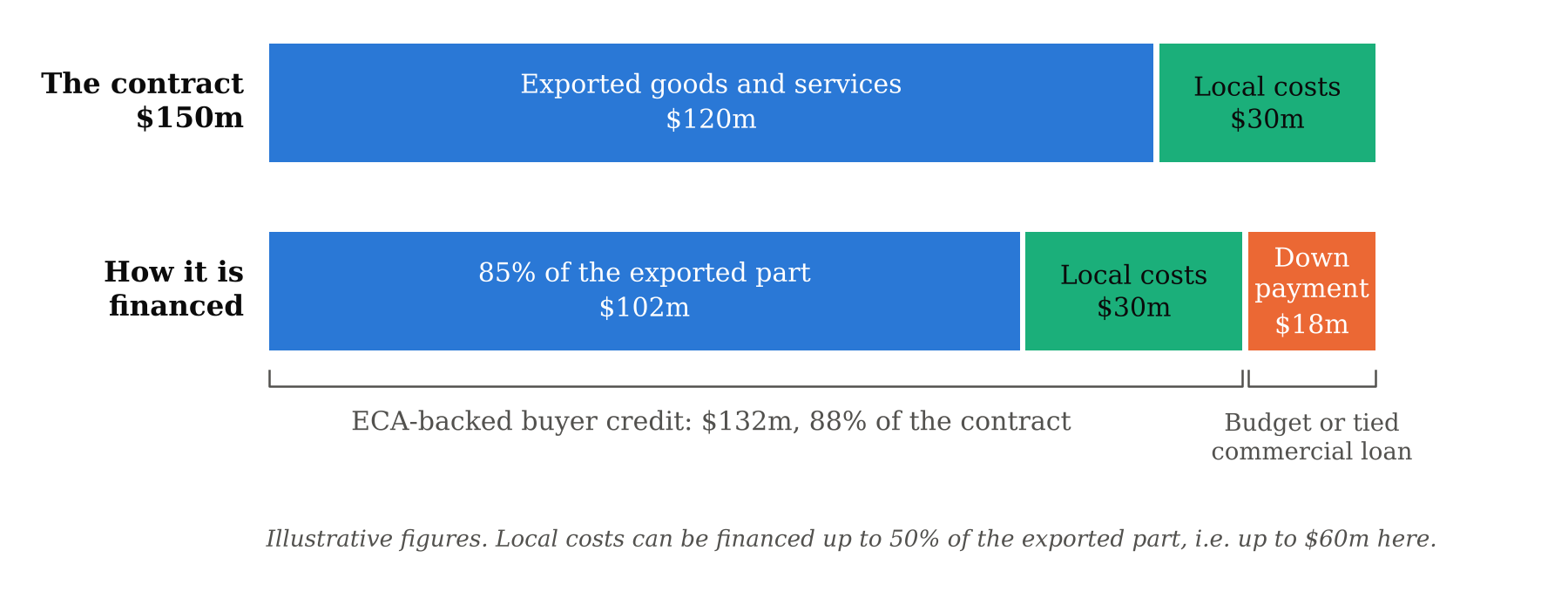
How the 85/15 rule and local costs shape the financing of a $150m contract (illustrative figures).
Civil works are, most of the time, local costs. The reason is simple economics: it makes little sense to hire workers in another country, fly them to the site and have them do work the local workforce can do, especially in frontier markets where local labour usually costs a lot less. Specialised work is another matter. On more complex projects, an LNG liquefaction plant for instance, part of the work is often done by foreign staff, because the local market does not have enough of the skills required.
The remaining 15% is a down payment that the buyer pays or finances elsewhere. During Covid this was temporarily relaxed to 5%, and that derogation expired at the end of 2024.
Second, the maximum tenor. Since the reform that took effect on 5 July 2023, repayment can run up to 15 years for all countries, up from 8.5 years for high-income OECD countries and 10 years for the others. Climate-eligible projects as well as nuclear power plant projects can go to 22 years. A hospital is not climate-eligible, so 15 years it is. And this comes on top of the construction period. I have worked on a recent nuclear power plant financing where the construction period led to the tenor of the loan reaching 30 years in total.
Third, the minimum premium. The ECA must charge a premium at least equal to a floor set by the Arrangement, which depends mostly on the risk category of the buyer's country, the length of the loan and the percentage covered. For Côte d'Ivoire at this tenor, UKEF's premium is 12.71% of the loan, paid upfront. Ghana's Komfo Anokye Teaching Hospital loan in 2019 carried a UKEF premium of 12.62%. The premium is usually paid upfront. It can be financed by the loan itself, which is what both countries did, but even then, it is paid out of the first drawing. In rare cases, an ECA accepts payment spread over time, but that is very much case by case. Either way, it is still a cost. As the comparison table above shows, it adds about three points a year to the all-in cost.
The use of proceeds. An ECA loan pays for one contract with one exporter, and the exporter must deliver a minimum share of content from the ECA's country. That minimum share is decided by each country. In the UK, for instance, it is as low as 20%. The German ECA, Euler Hermes, long required at least 51% German content, a threshold that drops to 30% for climate-friendly projects under its climate strategy. Since 2025, it has been moving to a broader assessment of the exporter's footprint in Germany, under its flex&cover reform.
The environmental and social obligations. ECAs apply the OECD Common Approaches and, behind them, the IFC Performance Standards. If you are not familiar with them, here is why they exist. They prevent lenders from financing projects that could damage the environment, are socially irresponsible, or have governance issues. These are the famous ESG principles: Environmental, Social and Governance. They ensure the highest standards are applied everywhere in the world, even where there are no such rules or regulations in the country where the project is built. Naturally, if local laws are stricter, the stricter norms apply.
Banks also have their own reasons. I know people like to think of banks as evil, greedy corporates, but they actually play a major role in promoting best practices. The last thing our shareholders want is to be in the middle of a scandal because we financed a project where the government forced the resettlement of its own population without proper compensation, for example. Not to mention that bankers are individuals like any other: we also pride ourselves in contributing to the greater good the best we can. We may agree to disagree as I am sure many readers won’t share that perspective.
In practice, every project is categorised. The Colas roads discussed in intro were Category B: impacts "few in number, site-specific, few (if any) of which are irreversible". Support is conditional on monitoring for the whole life of the loan. And the government, not the bank, must pay for the environmental and social due diligence, the resettlement studies where people have to move, and proper compensation. Part of a banker's job on these deals is educating the sovereign on obligations it did not know it was signing up to.
In the loan document, two clauses are essential. The first is the waiver of sovereign immunity: the government agrees that, in a dispute, it can be sued and its commercial assets pursued, usually under English law. Without it, a lender has no remedy against a state. Just think of it as a waiver of diplomatic immunity: it is a similar concept.
The second is what is often referred to as the Isabella clause. Almost every ECA-backed buyer credit documentation includes this clause. Wording varies, but it says three critical things: 1. the loan documents are separate and independent from the export contract; 2. the borrower's obligations under the loan do not depend on the validity, legality, enforceability or performance of the export contract; and 3. they are not affected by any dispute under the export contract, or by the insolvency of any party.
In plain English: if the contractor builds badly, late or not at all, the government's dispute is with the contractor. The loan is still due. The commercial contract is between the buyer and the exporter. The loan is between the borrower and the lenders.
Lawyers will tell you that under English law, a borrower would struggle to withhold repayment because of a contractor's failure even without the clause. Dentons made exactly that point in a 2023 note. But the clause still earns its place. Think about how the deal looks from the ministry's side: the loan exists only because of the contract, and the money never even passed through its hands, since it was paid directly to the exporter. It is very easy to see the whole thing as one deal, and to feel that you should not have to pay for a hospital that was never finished. The Isabella clause is there to make the answer clear before anyone asks the question.
The commercial contract is between the buyer and the exporter. The loan is between the borrower and the lenders.
The obligation survives everything. Governments change but the debt does not. A loan signed by one administration binds the next one, whatever it thinks of the project. That does not mean a new government will not try. But it would not go without consequences: creditors keep their claim and take it to the courts that govern the contract, usually English courts as per many international loans and commercial contracts. Look at Argentina, which defaulted in 2001 and spent fifteen years fighting holdout creditors in the New York courts before settling in 2016. Until it eventually defaulted again in 2020.
And if the country does not pay? Then the ECA pays the banks, as per its guarantee or insurance policy, and takes over the claim. The debt does not disappear; it becomes a debt owed by Côte d'Ivoire to the United Kingdom. We will see in Part V what happens next.
Risk of default is also why ECAs charge a premium. The premium does not cover the entire loan, far from it, but it adds a cushion against the losses an ECA may suffer in a restructuring or a rescheduling. And it is non-refundable in most cases: a borrower cannot claim it back once the loan is fully repaid. ECAs are not profit driven, but they are not a charity either. They must make sure the taxpayer gets value for their money, and that starts with not losing any in these schemes.
While the ECA world is a rather mature business, it has been evolving a lot over the past decade, to adapt to the new trends and dynamics of this world. For instance, several ECAs, UKEF among them since 2021, no longer support new oil and gas projects abroad, while providing more flexible and attractive terms for projects related to the energy transition. Others, such as the Korean and Japanese agencies or US EXIM, still finance gas and LNG. This gives commercial lenders a strong incentive to finance greener projects, and makes it easier for their sponsors to find attractive financing. We also already mentioned that ECAs have been widening their product offering to bridge the financing gap for critical minerals or energy transition, amongst others.
Moreover, the OECD Arrangement is being renegotiated again. A second modernisation round opened in 2026, and the banks' lobby, the European Banking Federation, has put its wish list on the table: a dedicated category for social projects, health included, with the same favourable treatment as green projects on premiums and tenors; the option to cover up to 95% of the contract instead of 85% for the riskiest countries; and local cost eligibility raised to up to 100% of the export value. None of it is agreed. If the social category goes through, it would apply to hospitals directly.
Governments change. The debt does not.
The full stack
Put it all together and a hospital financing in a frontier market rarely comes from a single source. It is a stack, and it is built in stages.
The early stages are usually paid for directly by the government: the design work and everything that comes before a contract. Sometimes the exporter pays for some of it itself, a pre-feasibility study for instance, as part of winning the deal. The lenders step in once a commercial contract is actually signed or at least at an advanced stage of negotiations. That is when a buyer credit is considered.
Then the ECA-covered buyer credit, the largest and cheapest piece. It can finance up to 85% of the exported part of the commercial contract, plus local costs up to 50% of that exported part, often with the ECA premium rolled in. Unless the project has a lot of local costs, a buyer credit can therefore finance a good 85% or more of the whole commercial contract. Sometimes it is split between a pure buyer credit and a direct lending tranche from the ECA. It does not happen often, but it does happen.
Then, for the balance, the down payment and the local costs the buyer credit could not include. The government can pay it from its budget, or finance it with what we call a tied commercial loan, usually from the same lenders as the buyer credit. It is shorter, five to seven years most of the time, and much more expensive, simply because the lenders are not covered by an ECA. Quite often, lenders will take out private insurance to cover that portion as well.
And when there are a lot of local costs, and strong local or regional banks, it makes sense to invite them in with a tranche in local currency, whose purpose is usually to finance those local costs. In a country with a strong local banking sector, Côte d'Ivoire being one, it is not rare to see local banks finance the local costs while the ECA, together with international lenders, finances the international contract.
You can always add more. If the country manages to secure concessional money from a fund or a DFI, you could have a concessional tranche, a buyer credit, a direct lending tranche and, sitting alongside, a small tied commercial loan. It can be as complex as we want, to some extent. The goal is the best structure for the client: one it can handle financially, meaning it can service the debt, and administratively, meaning it still makes sense to run.
Each facility carries a different tenor and a different cost, so the way you slice it matters for debt service. As a rule of thumb, a finance ministry wants the longest tenor and the cheapest margin. But not always. Some will tell you: "I don't need a loan that runs for 20 years. I'd rather repay it earlier and pay less interest." That is perfectly fine. You shorten the tenor, which means higher principal repayments at each repayment date, but if they can afford it, why not? It is always a balance, and it starts with understanding what the client needs.
The Tema–Aflao road we saw earlier is the simplest version: one UKEF-backed facility and one tied commercial loan, together covering 100% of the cost. The Ghana parliamentary record shows what this looks like in practice. For the modernisation of the Komfo Anokye Teaching Hospital in Kumasi, approved in April 2019:
-
A UKEF-backed facility of €122.5m, including €16.5m of UKEF premium financed within the loan. Guaranteed tranche at 6-month Euribor + 1.45%, a commitment fee of 0.75% a year, an arrangement fee of 1% flat. Tenor 12 years: 2 years' grace, then 10 years of repayment. Part of the facility was a direct UKEF loan priced off the euro CIRR.
-
A second, uncovered facility of €32.5m from the same bank: 6-month Euribor + 4.90%, 5 years.
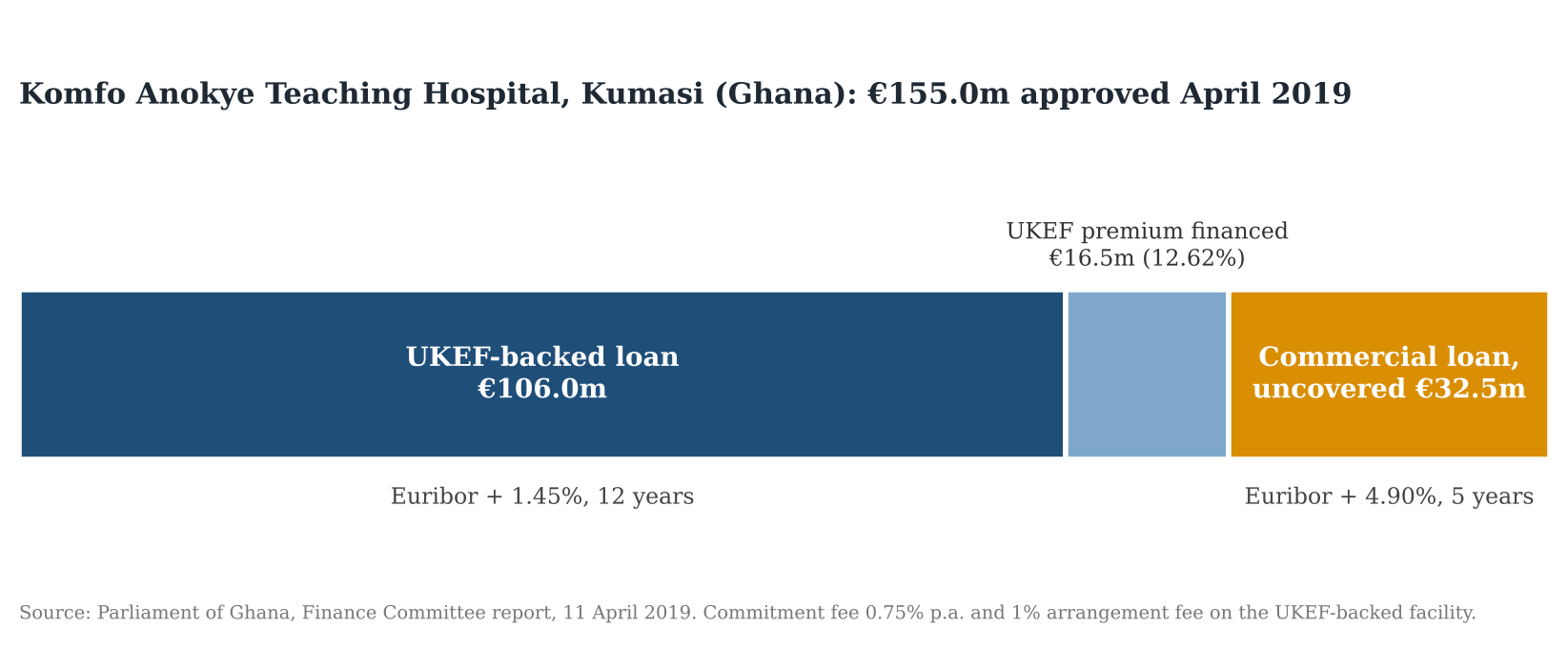
The financing stack of a real hospital: Komfo Anokye, Ghana, 2019. Source: Parliament of Ghana, Finance Committee report, April 2019.
Read those two lines side by side. Same borrower, same bank, same hospital: 1.45% over 12 years with the UK government behind it, 4.90% over 5 years without. That gap is the whole value of the ECA.
Koforidua followed the same pattern: €60.24m backed by UKEF over 13 years, and a €17.68m tied commercial facility alongside. Côte d'Ivoire's six hospitals: €241m from UKEF, €52m commercial from MUFG.
Same borrower, same bank, same hospital: 1.45% over 12 years with the UK government behind it, 4.90% over 5 years without.
ECA tranches in project finance
Everything so far is about lending to a government. But ECAs also sit inside large project financings, where the borrower is a project company and the lenders are repaid from the project's own revenues: a power plant, an LNG terminal, a mine. There, the ECA typically backs one tranche among several, covering the part of the debt linked to exports from its country.
The most recent large example in the UK is Sizewell C, which we already met with the National Wealth Fund. When the project reached financial close in November 2025, its financing included a £5bn export credit facility guaranteed by Bpifrance Assurance Export, France's ECA. This support from the French ECA is directly related to the presence of EDF Group’s commercial contracts (EDF, Edvance, Framatome, Arabelle Solutions) in this project. The press release from Bpifrance is quite interesting as it also gives more colour on what is actually being covered: up to £4.7 billion of the £5bn “against risks such as default, insolvency, political risk, natural disasters, and non-transfer.”
The release goes further and explains why it put down such a large ticket in this project. Quoting Bpifrance again: “This financing also demonstrates the State’s support for the French nuclear industry. The Sizewell C plant will significantly help maintain workloads at French industrial sites and generate more than €6 billion in direct economic benefits in France—not counting indirect benefits for numerous French mid-sized companies (ETIs) and SMEs.” This summarizes well the raison d’être of these governmental bodies.
Project financing often involves multiple ECAs. Given the complexity of the underlying project, there are often different packages being tendered by the project’s sponsors. Each package will be contracted to different contractors, and these different contracts may be eligible for different ECAs' cover. It is therefore usual to have a few ECAs, as many as eight for the largest and most complex projects, each providing cover for a dedicated tranche. The amount of these covered tranches is directly linked to the quantum of national content from that ECA.
For instance, take a $500m contract with $100m of UK content and $200m of German content. UKEF's 20% floor is met, so in theory it could support the whole contract. Euler Hermes, on the other hand, long required at least 51% of German content (its "49% rule" on foreign content), so at 40% it would more likely cover a tranche sized so that the German supplies make up 51% of it: up to about $390m.
Mozambique LNG is a good illustration. When TotalEnergies signed its project financing in July 2020, the biggest ever in Africa according to the company, the $14.9bn of senior debt included direct and covered loans from eight ECAs (US EXIM, JBIC and NEXI from Japan, UKEF, SACE, ECIC from South Africa, Atradius for the Netherlands and Thai EXIM), 19 commercial bank facilities and a loan from the African Development Bank. Worth noting this project did not go as smoothly as anticipated by the sponsors and the lenders, due to the tragic situation in Mozambique.
Shipping works the same way. On LNG carriers built in Korean yards, a typical package combines a tranche insured by K-SURE, usually at 95%, a direct loan from KEXIM for another part of the financing, and an uncovered commercial tranche sitting next to them. KEXIM is the interesting one here, because it often comes in as both a direct lender and a guarantor.
To conclude this section, it is also worth mentioning that ECA cover can also be extended to corporate financing. A foreign corporate could very well enter into a commercial contract with an exporter and therefore be eligible for the support of that exporter’s national ECA. As a matter of fact, a few ECAs have now launched more flexible products aimed at this part of the market, which used to be underserved. The traditional buyer credit is indeed often seen as not flexible enough by large corporates. While these products may offer more flexibility, their objective remains the same: to promote exports and ensure no export fails for lack of financing.
Part V. What actually goes wrong
Not the credit, the contractor
Here is the counter-intuitive part. With the ECA behind the loan, the bank's credit risk is largely covered. If Côte d'Ivoire stops paying, the UK government pays. It looks like a free lunch from a lender's perspective, at least with 100% cover. It is not quite one. Even fully repaid by the ECA, the lenders remain on the hook: as we will see, they owe the ECA a duty of care, and they will spend months, sometimes years, helping it recover the money, for free. So what does a banker actually worry about on a hospital deal?
Whether the hospital gets built. And whether anyone uses it.
Technically speaking, the debt does not care about either. Because of the clauses we just saw, the loan is due whether the hospital is finished or not, whether it opens or not, whether it treats a single patient or not. The performance risk does not sit with the lender's balance sheet. It sits with its reputation.
The lenders are not part of the contractor's selection and have absolutely no say in it. That is between the buyer and the seller. But they will run their own due diligence, especially on compliance (no bribery or sanctioned entities or individuals, amongst others) and on performance. The last thing a lender wants is to be on the front page of a local or international newspaper because it financed a massive project where the contractor did a poor job and the money is now due. It would reflect poorly on the lenders, even though they had nothing to do with it. And because they had nothing to do with it, they are entitled to the repayment of their loan, and they do not want to sit in the middle of a dispute between the two parties.
Therefore, the due diligence is mostly about the contractor. Does it have the skills to deliver a hospital, not just a building? Has it delivered projects internationally before? Does it understand the local market, the permits, the labour, the supply chain, the customs, the local regulations?
Then the things that always happen. Delays are common on large infrastructure, and they are usually handled by extending the availability period, the window during which the loan can be drawn. Cost overruns happen too, so the contractual due diligence checks that the money will be there to finish the job if the budget slips. Ideally, contracts are turnkey, so that the contractor bears the cost overruns risk. Lenders also look at who will operate the hospital, because a hospital built and never staffed is the reputational disaster they are trying to avoid.
In most frontier markets without a PPP framework, ownership of the hospital passes to the Ministry of Health as soon as it is built, and the ministry runs it. So, the performance risk on the lenders’ side is mostly about construction. Once the hospital has been delivered, hopefully on time, on budget and to the specifications in the commercial contract, it is down to the government to run it properly. Lenders still look at operation-related aspects of the project. A critical piece of information is, for instance, who will have access to that hospital. A hospital financed by the sovereign but dedicated to the royal family, for instance, is not something a lot of lenders would like to finance: it does not benefit the wider population while increasing the indebtedness of the country. Again, a reputational matter.
Furthermore, there is always one more question underneath the project, about the country itself: do we really want to put our name on additional debt for this sovereign? The cover protects the bank's balance sheet. It does not make an unsustainable debt sustainable.
The loan is due whether the hospital is finished or not, whether it opens or not, whether it treats a single patient or not.
Oman: when the contractor disappears before the first brick
The Oman hospitals are the deal where I learned what contractor risk really means. Using public data, I tried to make a short case study of what we just discussed.
In November 2017, Oman's Ministry of Health signed the contracts for three new hospitals, with the funding to come from the UK's export credit agency. Two of them, Khasab and Sultan Qaboos Hospital in Salalah, went to Carillion Alawi, a 50:50 joint venture between the British construction giant Carillion and the Zawawi family. The third, Al Suwaiq, went to International Hospitals Group (IHG).
Two months later, in January 2018, Carillion went into liquidation.
Its two contracts ended up with IHG, which took on all three hospitals under a PPP arrangement with the Ministry of Health. Except that IHG was a rather small company: a private, family-owned healthcare consultancy, design, construction and management firm, founded in 1972 and headquartered in Denham, Buckinghamshire. It had a limited track record on projects of this size. Given its involvement in backing Carillion from the start, UKEF kept supporting the project despite the change of contractor. After all, it was another British company.
Prospective lenders now had to take comfort from a small UK company acting as contractor on three hospitals, with close to $900m of financing at stake. That was the main point of discussion on this deal: the performance risk of the contractor. Lenders did not want another Carillion collapsing, this time midway through the construction of the hospitals.
A strong mitigant came from Oman itself. IHG partnered with Al Tasnim Enterprises, one of Oman's leading civil engineering and construction firms, as the primary subcontractor responsible for local execution, infrastructure and structural construction. Seeing Al Tasnim step in and provide some form of financial comfort, being a larger corporate than IHG, changed the picture. The deal closed, and GTR named it one of the best deals of 2019.
Koforidua: when it goes wrong
Koforidua shows what it looks like when it does go wrong. Again, this case study relies only on public data: I was not involved in this financing. It is a competitor’s deal, and nothing here is a criticism of its lenders: Ghana’s default hit many projects, financed by many institutions, including mine.
In July 2020, Ghana's then-president cut the sod for phase one of the Eastern Regional Hospital and said it "must be completed within the thirty-six month period and on budget". In December 2022, Ghana defaulted on most of its external debt. In December 2023, with the project about 30% complete, the contractors left the site citing unpaid funds, and the subcontractors followed. When Ghanaian journalists from The Fourth Estate visited in July 2026, they found no construction activity, weeds reaching the building entrances, and locked shipping containers left behind. The financing package has a 13-year repayment period. The loan clock is running on a building that is, in their words, "unfinished and unusable". Naturally, only the outstanding amount of that loan is due for repayment. The part that was left undrawn has been cancelled (i.e. not drawable any longer) and should the project restart, there will likely need to be new discussions around the financing of whatever work is left. I am not party to this deal, so this is an educated guess, based on how these loans usually work.
From experience, my understanding is that the default under other loans that were due to be repaid triggered a cross-default under the Koforidua loan, which was apparently still in the construction phase (as only 30% completed) therefore a priori not yet fully drawn. You can see it as a contamination mechanism: lenders assume that if a borrower defaults on one loan (above a pre-agreed threshold amount), there is a higher chance it will also default on its other loans. As a protection, lenders usually push for the inclusion of a cross-default clause, which triggers a default under their own loan preventatively whenever the borrower defaults under another loan. This has a few effects.
First, if the loan was not fully disbursed, which seems to have been the case here, there is what we call a draw stop: the loan cannot be drawn any further until the default has been resolved. Second, the lenders can accelerate the loan: declare everything outstanding immediately due, instead of following the original repayment schedule, and cancel whatever is left undrawn. This is not automatic. It takes a decision by a majority of the lenders and, on a covered loan, usually the ECA's consent, and an ECA like UKEF will often prefer to keep paying the instalments as they fall due. The draw stop and the cancellation of the undrawn amount are most likely what happened with the Koforidua hospital.
The money was ring-fenced for the contractor, the country lost access to it, and the debt kept going regardless.
Again, I have been using this example because it is one I came across recently, with enough information available in the public domain. It happens to be a competitor's deal, but my own employer has also had deals that defaulted. And I doubt any financial institution active in ECA finance has never seen any default.
In my early years in export finance, I even worked on the recovery of a loan that had defaulted in the early 2000s. I was still in middle school when that country defaulted, and over a decade later I ended up assisting an ECA, which shall remain unnamed, in the restructuring of that loan. Restructuring discussions take even longer than the initial structuring. Let’s now see what happens upon a default.
When a country cannot pay
Here is what happens after a default, when the ECA has paid the banks and holds the claim.
UKEF, for instance, does not usually pay off the whole loan on day one. It steps in and pays the instalments the borrower missed, as they fall due. Interestingly, some ECAs cover also the interest due under that loan. Some others do not. This position can last for a few years. At some point, if the situation of the defaulting borrower does not improve and the deal continues to be in default, UKEF may elect to prepay the lenders for the full outstanding amount. The deal disappears from the balance sheet of the lenders, but remains on the one of UKEF, who is now due all the defaulted money by the borrower.
The debt is now owed by one government to another, through its ECA. Government-to-government debt in default is traditionally restructured through the Paris Club. The Paris Club is an informal group of creditor countries that has coordinated sovereign debt treatments since 1956. The idea is simple: rather than each creditor chasing the debtor on its own, all of them sit at the same table and agree together on how to restructure and refinance the debt, so that the debtor's debt service makes sense again. It runs on a handful of principles. Decisions are taken by consensus. Creditors act as a group and share information. Each case is treated on its own merits. Relief is only granted to a country that has an IMF programme and commits to reforms. And the debtor must seek comparable treatment from its other creditors, so that the effort made by governments does not simply pay off private lenders.
For a borrowing country, this is also a strategic argument for ECA finance. In the end, you have one government discussing with another. A state like France or the UK will want to recover its money, but it is not in an extreme rush. It has no shareholders to answer to, so it can be more patient and more willing to make concessions than a commercial lender would be. Diplomacy steps in too, behind the curtain. Even when I was part of restructuring negotiations, there were dynamics on the ECA side that were not visible to us, and that I could not ask about anyway. Some of it sits with the foreign office. It is never black and white when governments talk to governments.
As we’ve just seen, Ghana is a recent example of what that looks like. Ghana defaulted on most of its external debt at the end of 2022. Its official creditors formed an Official Creditor Committee under the G20 Common Framework, co-chaired by China and France, with 25 members including the UK. A memorandum of understanding was agreed on 11 June 2024: debt service falling due between January 2023 and December 2026 was rescheduled, with lower interest and longer maturities, pushing the weighted average maturity of the treated debt from 2029 to 2038. The bilateral agreements with each creditor country were then signed one by one, from July 2025 onwards.
So, the export credit agency gets paid back in the end, just much later. This may look like an easy way out for the defaulting country, but it loses something harder to replace: for a period, nobody would lend to it "at any price", in the words of its own finance minister.
What it costs the banks. Being repaid by the ECA is usually not the end of the story for the lenders. They often have a duty of care towards the ECA, and they must assist it in restructuring the loan, offering their expertise pro bono. It is taxpayers' money, so greater care is due. And it takes ages. It brings to the table many parties with different interests. Different creditors have different tactics, and all of them want to be repaid first.
In practice, who is paid first is dictated by the seniority of the financial instrument. Secured debt has a first claim on any asset secured to it. Then unsecured senior lenders are considered. And we go down the ladder like that, all the way towards the most junior debt. ECAs usually require the debt they cover to rank at least pari passu with existing creditors. They are therefore at the highest order of priority, but may share that position with other creditors.
Restructuring and recovery discussions are intense negotiations, spread over months if not years. During that time, the bank works for free on behalf of the ECA: it already has recovered its money and no longer earns any interest on the loan. Yet it must assist with highly technical work, under a lot of pressure, on top of its regular job of originating and structuring new deals.
During a restructuring, the bank works for free: it has already recovered its money, yet has to do a lot of highly technical work, under a lot of pressure.
Defaults that have nothing to do with credit
So far, we have talked about countries that cannot pay. But some defaults have nothing to do with credit. Remember Bpifrance’s comment on Sizewell C: it also covers, amongst others, insolvency, political risk, natural disasters, and non-transfer. In those cases too, the lenders can file a claim under the ECA cover, if default is continuing with no remedy in sight. The recovery is a completely different story.
Sanctions. Loan documents name the sanctions lists that apply. When an international lender is involved, UK, EU, UN and US sanction lists (sometimes more) are referred to in the loan documentation. If the borrower or its guarantor (or another obligor to that loan) ends up listed on one of these lists, it triggers an event of default. And this default cannot be cured: how would a counterparty get itself off a sanctions list? Not something that is curable overnight or even within a few months. It does happen, but slowly: the US sanctioned Rusal in April 2018 and only removed it from the list in January 2019, once Oleg Deripaska had given up control. For instance, when Russia invaded Ukraine in 2022, every bank had to deal with a new set of sanctions against Russian counterparts, and some deals were caught in that net. Arctic LNG 2, Novatek's $21bn liquefaction project, is a public example: within days of the invasion, Italy froze a loan of about €500m from Cassa Depositi e Prestiti, to be guaranteed by SACE, before a single euro had been disbursed.
Environmental and social breaches. If a sovereign breaches a resettlement commitment in the middle of construction, the usual response is an event of default related to E&S, leading to a draw stop. That does not mean the loan is called. It is usually curable: there will be an action plan to get things moving in the right direction. However, if this does not get resolved or if stakeholders are acting in bad faith, this will turn into a continuing event of default, at which point the lenders can accelerate the loan and claim under the ECA cover.
The clearest public example comes from development lenders rather than ECAs, but the mechanism is the same. In March 2016, after the murder of Berta Cáceres, the Honduran activist who had led the opposition to the Agua Zarca dam, the Dutch development bank FMO and Finland's Finnfund suspended their disbursements to the project.
In practice, stakeholders have many discussions before triggering such clauses (unless this relates to sanctions or illegality, in which case this is a black or white matter). Many of these situations can be resolved in a way that has limited impact to the loan and to the various stakeholders. But if some of the stakeholders act in bad faith or if the situation does not improve despite all the efforts, these clauses exist to protect the lenders. I have financed many deals in my close to 15 years of experience, and I cannot recall a deal of mine that ended in a default unrelated to credit or sanctions. This does not mean all the deals were a walk in the park, to the contrary.
The Chinese offer
Chinese bidders often win these tenders, and their offer is hard to beat on paper: a cheaper project, and financing that looks cheaper too, sometimes with security features attached, such as a claim on a revenue stream or an asset. Their ECA, Sinosure, is not bound by the OECD Arrangement and can therefore bend the rules, and the Chinese state also finances many of these projects directly, through its state-owned commercial banks and policy banks.
In that latter case, the problem is that the terms are opaque, so the comparison is rarely like for like.
We know more than we used to. In 2021, a team of researchers from AidData, the Kiel Institute, the Center for Global Development and the Peterson Institute published "How China Lends", the first systematic study of 100 Chinese loan contracts with governments in 24 developing countries. They found unusual confidentiality clauses that bar borrowers from revealing the terms, and in some cases the existence of the debt. They found "no Paris Club" clauses, designed to keep the debt out of collective restructuring. And they found collateral arrangements, such as lender-controlled revenue accounts, that give the lender an advantage over every other creditor.
And what about strategic infrastructure ending up in Chinese hands? The case everyone cites is Hambantota, the deep-sea port in southern Sri Lanka built with Chinese loans. In 2017, struggling with its external debt, Sri Lanka leased a 70% stake in the port to China Merchants Port Holdings for 99 years, for $1.12bn. It is usually told as a port seized against unpaid debt. The reality is messier, and more interesting. The Chinese loans were not cancelled or swapped: Sri Lanka still pays just over $100m a year on them. The $1.12bn went to shore up the country's foreign reserves and repay other debts. It was a fire sale of a strategic asset to a Chinese state company, not a creditor enforcing its security.
Laos is closer to the pattern. Heavily indebted to China after its hydropower projects and the China-Laos railway, the country agreed in 2020 to create a new company to run its national electricity transmission grid with China Southern Power Grid, which, according to people familiar with the deal, took majority control. Neither government has published the shareholding.
That does not mean all Chinese financing is bad. Plenty of Chinese-built infrastructure works, and Chinese lenders have filled a gap that Western ones left open for years. But it has been documented that some of these arrangements are very lender friendly, and a finance ministry comparing two bids should know which clauses to look for.
Now the fair objection. Western export finance has strings too. National content requirements tie the project to the exporter's country. The 85/15 rule forces the buyer to find 15% elsewhere. The premium is a large upfront cost, even though it can be financed and therefore spread over the life of the loan. And the waiver of sovereign immunity is not a small thing to sign. It is also worth highlighting that Sinosure-backed deals are, in the end, very similar to any other ECA-backed deal: they just have more flexibility around tenor, minimum content or premium level than their OECD counterparts. Someone in a finance ministry could reasonably say that every lender attaches conditions, and that Western ones are simply better at presenting theirs.
But here's the thing. The Western strings are public. The OECD Arrangement is published. UKEF publishes its project decisions, down to the environmental category of a road in Agnibilékrou. Ghana's parliament published the margin, the premium and the fees of its hospital loans. When Ghana defaulted, its Western ECA debt went into a restructuring with published terms, and China sat at the same table as co-chair. You can disagree with the strings, but at least you can read them.
You can disagree with the strings, but at least you can read them.
Part VI. Under the hood
This part is for readers who want to see the machinery. If you only wanted to know how a country pays for a hospital, you can skip to the conclusion.
Who actually earns what
Let me go back to the Tema–Aflao road in Ghana, because its terms are public, and run the same numbers from the other side of the table: not what Ghana pays in percentage terms, but where every dollar goes.
On the same assumptions as before (reference rate held at 4.33%, construction spent over three years), here is what Ghana is estimated to pay over the life of the two loans, for $105.9m of actual construction work:
| Where the money goes | $m |
|---|---|
| Repayment of the construction money | 105.9 |
| Repayment of the UKEF premium, financed in the loan | 12.1 |
| Interest at the reference rate (the lenders' own cost of funding) | 31.1 |
| Lenders' margin, UKEF facility (0.80% a year) | 5.2 |
| Lenders' margin, tied commercial facility (5.00% a year) | 3.5 |
| Fees: arrangement, commitment and agency | 1.5 |
| Total paid by Ghana | 159.3 |
Assumptions: reference rate held at 4.33%; drawings spread evenly over construction (three years for the UKEF facility, the first year for the tied loan); both loans repaid in equal semi-annual instalments, starting six months after the grace period; no commitment fee on the tied loan, since none is stated. All terms are from the Finance Committee report of 16 December 2019.
Two things stand out.
The premium is the biggest single cost of the deal. At $12.1m, UKEF's premium is larger than everything the banks earn above their own funding cost, on both facilities combined: $10.2m of margin and fees. And Ghana pays interest on the premium too, since it is borrowed. That said, the premium is not profit for the UK. It is the cushion against the losses UKEF may one day suffer on the loan.
The banks' share is thin. Take a bank holding half of the UKEF facility, which is realistic on a deal this size: $46.5m. Over 13 years, it earns about $2.6m of margin (noting it actually bears additional funding costs, so it is not a net income), plus about $0.2m of commitment fee and $0.35m of arrangement fee. About $3.1m in total, or roughly $0.24m a year, against a $12.1m premium for UKEF, on a loan it has to administer, monitor and, if things go wrong, help restructure for free. That is why banks need volume, and why small deals struggle to find lenders.
At $12.1m, UKEF's premium is larger than everything the banks earn above their own funding cost, on both facilities combined.
Each line of a loan pays for something different. The arrangement or structuring fee, and any upfront fee generally, pays for the work of putting the loan together: analysing the risk, and all the time spent with the borrower finding the best structure and terms. The margin pays for the credit risk over the duration of the loan. The commitment fee pays for the fact that the lenders are committed: if the borrower does not draw on day one, it does not want to hear a year later that the money is no longer available. Keeping that money ready ties up some of the lenders' capital, and the commitment fee remunerates that, usually 30% to 40% of the margin on structured finance deals. Ghana's was 40%. The agency fee covers the administration: every drawing request and every waiver request must be processed by someone. On a complex deal with many lenders and several facilities, there may also be a coordination fee for the bank pulling it all together. And sometimes an underwriting fee, when one lender commits to the full amount and takes the risk of finding other lenders, at whatever price it negotiated, afterwards. It gives the borrower certainty, but it is not common in export finance: most deals are club deals, where a few banks are invited to arrange the financing together from the start, as in Oman.
Content: what the exporter must prove
Content is where the exporter does most of its paperwork. Once the deal is signed and construction starts, the ECA checks that the content promised is the content delivered. How deeply depends on the ECA. Some look at every single invoice on every single project and calculate the content themselves. Others ask the exporter to self-report and run spot checks from time to time. Either way, it is a cumbersome process.
What if the exporter falls short? Say it promised 51% German content yet delivered only 46%. Not every shortfall is fraud. Most isn’t as a matter of fact. A sub-supplier may have gone bankrupt, or had such delays that the exporter had to find a replacement somewhere else. There had been cost overruns on a part of the project with limited German content, leading to a lower share of the German content. That can be perfectly rational, and therefore perfectly fine.
But for the lenders, it changes nothing. The bank has no control over the content and nothing to do with it. Once the ECA's guarantee or insurance policy is signed, it is binding, and it does not fall away because the minimum content was not met. The consequence, if there is one, lands on the exporter: the next time it seeks ECA support, the ECA may be more reluctant if it failed to deliver on its last commitment without a good explanation. Even with a good explanation, the ECA may be more stringent.
Once the ECA's guarantee is signed, it is binding. It does not fall away because the minimum content was not met.
Cheap money, with strings
So, back to the question. How does a country like Côte d'Ivoire pay for a public hospital?
In most cases, with export finance. Not because it is free, the premium alone is a serious cost, but because it is the only option that offers rather cheap financing and a long tenor at the same time. The alternatives are either expensive or short-term. Often both.
That is not dogma. If a country has deep access to bond markets, or a strong base of local banks, it should use them, and the best structures often mix all three: local banks for the local costs, ECA financing for the international contract, and the bond market kept in reserve for what only the bond market can fund. A bond is a fine instrument as long as you account for the cost of carry and your all-in cost comes out below the equivalent ECA loan.
But the money comes with strings: a contract with one exporter, a premium paid upfront, environmental obligations for the life of the loan, and a debt that stays due whether the hospital opens or not.
Cheap money. Long money. Not free money.
Resources
If you want to go further:
- My earlier article on Dantes, Learning Structured Finance for Free, a reading list of free resources across structured finance: project finance, export credit, leveraged transactions. It is the reading list I wish someone had handed me at the start.
- EDHEC Business School and Société Générale, Global Financing Solutions (Coursera). An introduction to structured and export finance, including the case study of the Cairo monorail.
- OECD, Arrangement on Officially Supported Export Credits (January 2026 consolidated text), and the OECD's page on the Arrangement and its sector understandings. The rulebook itself, with the country risk classifications.
- UK Export Finance, Category A and Category B projects supported (gov.uk). Every Category A and B project UKEF supports is published, with its environmental assessment. A free library of real deals.
- The Paris Club (clubdeparis.org). Every agreement, including Ghana's 2024 treatment, with dates and terms.
- Paris Club, What are the main principles underlying Paris Club work?. The rules of the table, in two pages.
- Anna Gelpern, Sebastian Horn, Scott Morris, Brad Parks and Christoph Trebesch, How China Lends: A Rare Look into 100 Debt Contracts with Foreign Governments (AidData, Kiel Institute, CGD and PIIE, 2021).
- World Bank, PPP Resource Center (formerly the PPP Legal Resource Center). What a bankable PPP framework looks like, country by country.
- Dentons, Export finance: what is the point of the Isabella clause? (July 2023).
- National Audit Office, PFI and PF2 (January 2018). The numbers behind the UK's PPP experience.
- National Audit Office, Investigation into the rescue of Carillion's PFI hospital contracts (January 2020). What happens to a PPP hospital when the contractor collapses.
- Bpifrance Assurance Export, Règles de part française (in French). How France defines and checks French content, if you want to see what an exporter actually has to prove.
- UK Export Finance, UKEF's approach to foreign content. The British equivalent.
- GTR, Rearranging export finance (2026). Where the OECD Arrangement renegotiation stands.
Books
In the order I would read them:
- Edward Farquharson, Clemencia Torres de Mästle and E. R. Yescombe, How to Engage with the Private Sector in Public-Private Partnerships in Emerging Markets (World Bank and PPIAF, 2011). Free. PPPs seen from the side of an emerging-market government, including where DFIs and ECAs fit in, with two hospital case studies (Guanajuato in Mexico, Inkosi Albert Luthuli in South Africa). The place to start.
- E. R. Yescombe, Principles of Project Finance (2nd edition, Academic Press, 2013). The standard text on how a project financing is put together, with a chapter on ECAs and DFIs and where their tranches sit next to the commercial banks. Written before the 2023 changes to the Arrangement.
- Zlatko Salcic, Export Credit Insurance and Guarantees: A Practitioner's Guide (Palgrave Macmillan, 2014). The only book-length treatment of how ECA cover actually works: buyer credit, direct loans, premium, foreign content, claims and recoveries. Also written before the 2023 changes.
- OECD, Smart Rules for Fair Trade: 50 Years of Export Credits (2011). Free. Why the Arrangement exists, told by the people who negotiated it, including Janet West, who ran the OECD's export credits division for sixteen years.
- S. Ali Abbas, Alex Pienkowski and Kenneth Rogoff (eds.), Sovereign Debt: A Guide for Economists and Practitioners (Oxford University Press, 2019). Why sovereigns borrow, how they default and how a restructuring is actually run, with a chapter on the restructuring process co-written by Lee Buchheit. Written before the Common Framework and Ghana.
- Michael Pettis, The Volatility Machine: Emerging Economies and the Threat of Financial Collapse (Oxford University Press, 2001). Money of the right shape, applied to a whole country: how the currency and maturity of a sovereign's debt turn an outside shock into a crisis. Denser than the rest.
- AidData, Belt and Road Reboot: Beijing's Bid to De-Risk Its Global Infrastructure Initiative (2023). Free. The sequel to How China Lends: rescue lending, cash collateral accounts, and why China is the hardest creditor to bring to the restructuring table.
Sources
The deals
- UK Export Finance, Category B project supported: Roads and Bridges Project, Côte d'Ivoire (30 November 2021).
- UK Export Finance, UKEF supports major hospital construction in Ivory Coast (5 August 2021); GTR, UKEF in 'biggest ever' West Africa facility for Côte d'Ivoire hospitals (August 2021).
- GTR, Standard Chartered and UK Export Finance back Ghana hospital build (29 July 2020).
- UK government, Government backs UK firm to build three hospitals in Oman (2 January 2020); Oman Observer, RO 270 million for new hospitals (16 November 2017) and PPP-based Oman hospitals named among Best Deals of 2019 (21 May 2020).
- Lawton Tubes, Lawton Tubes wins contract for triple hospital build in Oman (9 May 2024).
- UK Export Finance, SME consortium builds hospitals in Ghana with UKEF support (21 July 2015).
- Parliament of Ghana, Finance Committee, report on the US$93m UKEF-guaranteed facility for the Tema–Aflao road, phase I (December 2019), and report on the Komfo Anokye Teaching Hospital facilities (April 2019).
- The Fourth Estate, From Promise to Neglect: What Happened to Koforidua's €70 Million Regional Hospital? (19 August 2026).
- EDF, EDF announces the financial closing of the Sizewell C project (4 November 2025); World Nuclear News, Sizewell C gets final go-ahead decision (22 July 2025); Bpifrance, France supports Sizewell C with £5bn loan guarantee (23 January 2026); National Wealth Fund, National Wealth Fund backs UK nuclear ambitions with milestone Sizewell C financing (22 July 2025); The Banker on the Sizewell C financing.
- TotalEnergies, Total announces the signing of Mozambique LNG project financing (17 July 2020).
- Trafigura, Trafigura signs USD1.1 billion loan agreement to support the long-term supply of critical metals to German industry (23 February 2026).
- US Department of Energy, Department of Energy Announces American Nuclear Supply Chain Loans (23 June 2026).
Rules, institutions and policy
- OECD, Arrangement on Officially Supported Export Credits (TAD/PG(2026)1, January 2026); Mayer Brown, OECD Arrangement on Officially Supported Export Credits (8 August 2023), on the July 2023 reform.
- GTR, Rearranging export finance (issue 3, 2026); European Banking Federation, EBF Position Paper on Modernisation 2 of the OECD Export Credit Arrangement (June 2026).
- UK Export Finance, About us; Record £14.5 billion of export financing supports 70,000 jobs (17 July 2025); UKEF's approach to foreign content (updated October 2025).
- Bpifrance Assurance Export, Règles de part française.
- Euler Hermes, Climate strategy for the Federal Export Credit Guarantees; GTR, Germany aims to boost struggling industry with export credit revamp (2025).
- UK government, How the government will implement its policy on support for the fossil fuel energy sector overseas (31 March 2021).
- World Bank, IDA borrowing countries.
- Ministry of Finance, Ghana, 2026-2029 Budget Preparation Guidelines (2025); Ghana's Government Has Reached a Memorandum of Understanding with Its Official Creditor Committee (12 June 2024).
- Paris Club, Ghana: debt treatment, 11 June 2024 and What are the main principles underlying Paris Club work?.
- Dentons, Export finance: what is the point of the Isabella clause? (12 July 2023).
Markets and countries
- Banque de France, Webstat, series FM.M.DE.EUR.FR2.BB.DE10YT_RR.YLD (German 10-year government bond yield, monthly average), for the Bund chart.
- Il Sole 24 Ore, France: 10-year OAT yield rises to 3.90 per cent, the highest since 2009 (8 July 2026).
- World Bank, Côte d'Ivoire GDP, via FRED; World Bank, Economic Update for Côte d'Ivoire: Cacaoland (July 2019); Team France Export, on the 2026 Ivorian road budget (February 2026, in French).
- Cleary Gottlieb, Côte d'Ivoire in $1.75 Billion and XOF220 Billion Offering and Concurrent Cash Tender Offers (April 2025).
- Federal Reserve Bank of New York, Secured Overnight Financing Rate data.
- NPR, Argentina Reaches Settlement With Hedge Funds, Ending 15-Year Dispute (29 February 2016); Al Jazeera, Argentina defaults again as debt talks progress (22 May 2020).
PPPs
- The Local, Finance Minister calls for inquiry into hospital scandal (7 February 2018).
- Mark Hellowell, Are public–private partnerships the future of healthcare delivery in sub-Saharan Africa? Lessons from Lesotho, BMJ Global Health 4(2) (2019).
- National Audit Office, PFI and PF2 (18 January 2018) and Investigation into the rescue of Carillion's PFI hospital contracts (17 January 2020).
Sanctions, E&S and Chinese lending
- US Treasury, OFAC Delists En+, Rusal, and EuroSibEnergo (27 January 2019).
- Reuters via ArcticToday, Italy freezes loan for Russian Arctic LNG 2 plant, sources say (1 March 2022).
- Business & Human Rights Resource Centre, Finnfund suspends disbursements to Honduran hydropower project (16 March 2016).
- Gelpern et al., How China Lends (AidData, 2021).
- Umesh Moramudali, The Hambantota Port Deal: Myths and Realities (The Diplomat, January 2020).
- South China Morning Post (Reuters), Chinese firm 'to take majority control' of Laos' electric grid (2020).
The Tema–Aflao figures (all-in costs and who earns what) are my own estimates from the published loan terms; the assumptions sit under the tables.
All examples in this article are drawn from public sources. Views are my own and nothing here is investment, legal or financial advice.
Go deeper
Test your understanding of Structured Finance
Explain it out loud. An AI tutor listens and asks questions that expose gaps you didn't know you had.