
Winner winner, chicken dinner! If you know what that means, chances are that you've either been in a casino in Vegas or, just like me, you've watched the movie 21, which tells the story of the MIT students who carefully conducted a legal heist in Vegas casinos, back in the nineties. Legal heist, yes, you read it well.
These smart kids used their mathematical aptitudes to count cards and, as a group, went on the blackjack tables to take the best out of the odds. It did not take me much more to get fascinated by casinos. Like everyone else, a few years earlier, I had watched Casino Royale, the famous James Bond movie where our favourite spy plays a high stake game of poker in a fancy casino of Montenegro. Casinos have that capacity to sell a glamorous dream to attract you and make you forget you're playing your money in the least financially rational way possible. They make you believe that wealth is waiting two cards away from you, a bit like the lottery. Unlike the lottery, however, they are very good at making you believe you've got some form of control. Blackjack is their perfect showcase, famously branded as the game where you've got the highest chance against the house. This is not untrue: the house edge on traditional European rules is 0.62% if you play basic strategy, and 5.48% if you play "naively", according to the Wizard of Odds. You read it well: the house edge. Meaning that even with a well-defined and proven strategy, over the long term, you're still losing money.
I was aware of these facts. My very first move after watching 21 was to actually check the veracity of the story (there is a famous book about it: Bringing Down the House, by Ben Mezrich): it turns out it is largely romanced. Then to learn how to play blackjack — a very easy game to understand, less so to play if you want to be strategic. Very shortly after, I checked how complex it was to count cards: spoiler alert, it is not difficult at all. It requires a bit of training, but no need to be a mathematician or have any formal education: the most used technique just requires you to add or subtract one to a sum you keep in your mind. That's it, yes.
My plan was flawless. I just did not anticipate that graduating from the MIT would not really be an option for me. Tough life.
A few years later, in my twenties, with my own hard-earned money, I visited Deauville's casino. This was my very first time playing and I spent the whole evening at the roulette. Needless to say, I went home poor. Since then, I enjoy spending a few hours during holidays in casinos and have been studying here and there some tactics to improve my odds. Now, this is not the work of a professional player or a gambler. I am just an occasional player, going at most two to three times a year in a casino, with a maximum bankroll of a couple of hundred euros, shared with my wife usually. I have never played online and never play where I live, in the UK: it is a holiday activity, if in the mood, and if nearby.
When Bastien heard about Dantes, he reached out to assess my interest for an article on poker, based on his amateur, yet intensive, experience. I thought it could be a good idea to investigate the topic deeper as it would make an article different from what I've been writing so far. And I could share my own experience with the game I enjoy and play the most, blackjack. This article is not a thesis trying to demonstrate whether a player can beat the house, though while the theory may say otherwise, the answer is obviously no.
Indeed, if a secret sauce existed, all casinos would shut down or remove the game from their offering. For most casino games, the house advantage can be precisely measured thanks to probabilities. Most of these games (slot machines, baccarat, roulette and so on) are what we call fixed odds games: the player cannot alter the house advantage, meaning that in the long run, they will end up losing money.
But a few games, of which blackjack belongs alongside pai gow (domino gambling game, famous in Asia) or its poker variant, have elements of strategy that can impact the house edge: there is a mix of chance and skill. In 1998, Olaf Vancura and Ken Fuchs revolutionised blackjack strategy by publishing their landmark book, Knock-Out Blackjack: The Easiest Card-Counting System Ever Devised. Their work mathematically bridges the gap between skill and chance. If Edward Thorp proved in the early 1960s that blackjack could be beaten, Vancura and Fuchs made that edge accessible to ordinary players with Knock-Out Blackjack, an unbalanced count that removes the error-prone true-count arithmetic. Less math-brainiac players finally had access to a counting method that stripped away complex mental math.
And de facto, casinos have been fighting any new edges that players could come up with (among which, card counting, technology). Therefore, the more interesting question relates to the strategies, when available, that can be used to increase our odds: is the time investment worth it?
In a first section, we will explore the maths behind casino games and recalculate the odds of a couple of games, before moving into a second section related to the strategies to get a more favourable disadvantage over the house in the game of blackjack.
We will then move on to Bastien's favourite game, poker. I will rely a lot on his story as well as the testimony of professional players, as my own experience with this game is limited to friendly games and a couple of sessions in a casino. I have nevertheless done my homework and read through various sources to paint a syllabus for anyone who would like to start playing this extremely complex game. And because I will have spent a lot of time studying the theory around poker, I will give it a try to see whether hours of reading poker books and watching videos on strategy without ever practicing are enough to start with a decent level.
Learning how to truly play well requires dedication and patience. I am not sure I will be able to apply that to learn poker: I must admit I lack time (spent on writing articles like this one, for instance), and I am not certain it is a game made for me anyway. But again, I promised I will give it a fair try, for the purpose of this article.
What the house edge actually is
In his 1899 masterpiece "The Theory of the Leisure Class", the American economist and sociologist Thorstein Veblen outlined that the casino mindset relies heavily on a belief in luck and unseen forces. Therefore, before getting into the nitty gritty of any strategy or game mechanics, it is important to understand the mathematics behind the odds. This understanding is, in my opinion, a prerequisite for playing more consciously and responsibly.
None of this changes the fact that going into a casino is not a rational thing to do, and Veblen's theory expands on the topic on how wealthy people display their status. It would however be extremely reductive to limit his theory to these outlines, though sociology is not the purpose of this article. I'd nevertheless encourage you to read this book as it is still very accurate and explains why influencers exist nowadays.
He explains, in particular, why the expensively-priced casino games are the prestigious ones: baccarat and the high-limit room are conspicuous consumption, and conspicuous consumption is a pricing theory.
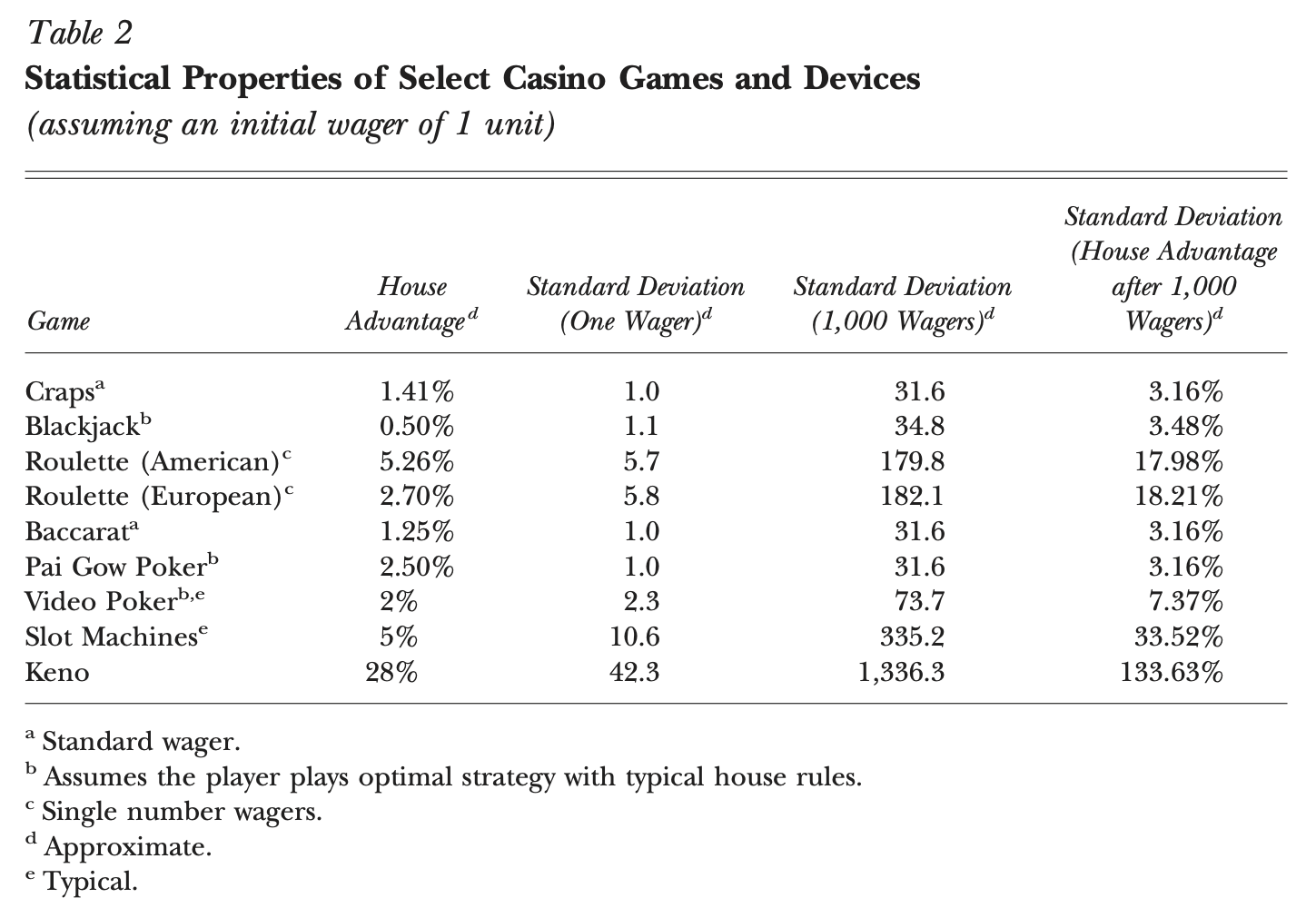
Table 2 from William R. Eadington, "The Economics of Casino Gambling", Journal of Economic Perspectives 13(3), 1999.
The two numbers everybody confuses: house edge and hold
Before we go deeper into the games, let's explain two recurring concepts. The house edge is the expected loss per unit wagered. A 1.25% house edge in baccarat means that for each euro played, the player loses 1.25c, on average, over the long term.
This is not what the casino earns: it actually keeps the "hold", which is defined as the win divided by the drop (the cash you exchanged for chips).
This may seem counter-intuitive, but these two numbers are widely different. As per the latest Gaming Revenue Report dated June 2026 by the Nevada Gaming Control Board, blackjack holds 12.83% over the last twelve months. Before we discuss this number, a precision worth making: it is a metric as a share of drop, and not of amount wagered. It means that it counts every buy-in, including re-buys after busting. Difficult to compare like for like with the actual hold, but still worth having in mind the basic-strategy house edge at near 0.5%. The hold is roughly 25 times the house edge, though, again, the two are not measured against the same base. Roulette is less profitable with a hold of 19.11% against a 5.26% edge on a double-zero roulette (same here, not a like-for-like comparison). The only games where these two numbers are the same thing are penny slots, because slot win is measured against coin-in rather than drop.
In layman's terms, it just means that when a player buys in a table game, they usually do not go all-in and leave. They bet smaller wagers, cumulatively a multiple of the cash originally exchanged for chips. Each of these wagers has an expected casino win defined by the house edge. On average, the player will leave with a loss corresponding to that house edge multiplied by the cumulative wagers. To put it in numbers, in a very conservative way, if a player has bought in €200 worth of chips, wagering €4 per hand for three hours, at a pace of 40 hands per hour, and playing perfectly the basic strategy, the player is expected to lose:
Hence leaving the table with €197.6, meaning a hold of:
The key thing to understand here is that you're looking at an average of all the players, in one given night: most players do not play basic strategy, and even those who do, do not play it perfectly. Some may win big; some may lose it all. But on average, the casino will hold 12.83% of the drop.
One calculation, done on the page
The house edge is only a matter of rules set by the casino. To give a concrete example, using the game of roulette.
A winning wager on a single number of a European wheel (i.e. a single zero) would pay 35 to 1. The ball stopping on your number, 0 to 36, bears a probability of 1/37. Hence a house edge of 2.70%.
On an American wheel, same bet, same payout, but one extra pocket: probability of 1/38.
The house edge is twice that of the European version of the game: 5.26%
Identical layout, identical payouts, identical experience, yet the American wheel is 95% more expensive. The price of a casino game is a design decision, invisible from the chair. This is the reason why casinos create new versions of each game. Casinos tend to market these alternatives as their way to entertain new users or existing ones who got "bored" from the classic version... Truth is, the key purpose of these new games is increased profitability.
Why the edge does not feel like the edge: variance
If you've been in a casino or watched players, including in movies, you will have noticed that the house edge does not really translate into such "small losses". Considering my previous example of a casual yet very strategic player playing €200 worth of chips over 120 hands of €4 wager, that player is expected to leave the table with €2.4 less. And even if we were to consider a house edge three times higher at 1.5%, that player would leave the table €7.2 poorer. On average.
It sounds therefore safe to play. But also, boring and somehow useless, as you're not expected to win big either. Fair. But this would be dismissing the variance of the game.
Considering the table sourced from Eadington, basic strategy at blackjack has a 0.50% edge, for US optimal play. Meaning that after a thousand hands, a player would be, on average, behind by 5 units. The Wizard of Odds estimates it at 0.62% for the European version, i.e. behind 6 units after a thousand hands. Now, if you're familiar with probabilities, you know the Central Limit Theorem. If not, it states that if you take a large enough sample size (noting that a sample size ≥ 30 is widely accepted as large enough), the distribution of the sample means will closely follow a normal distribution, more commonly known as a bell curve.
In a normal distribution, 95% of the values are located within the range going from the expected value minus two standard deviations to the expected value plus two standard deviations. Given the standard deviation associated with basic strategy in blackjack, over a thousand hands the total standard deviation is roughly 34.8 units.
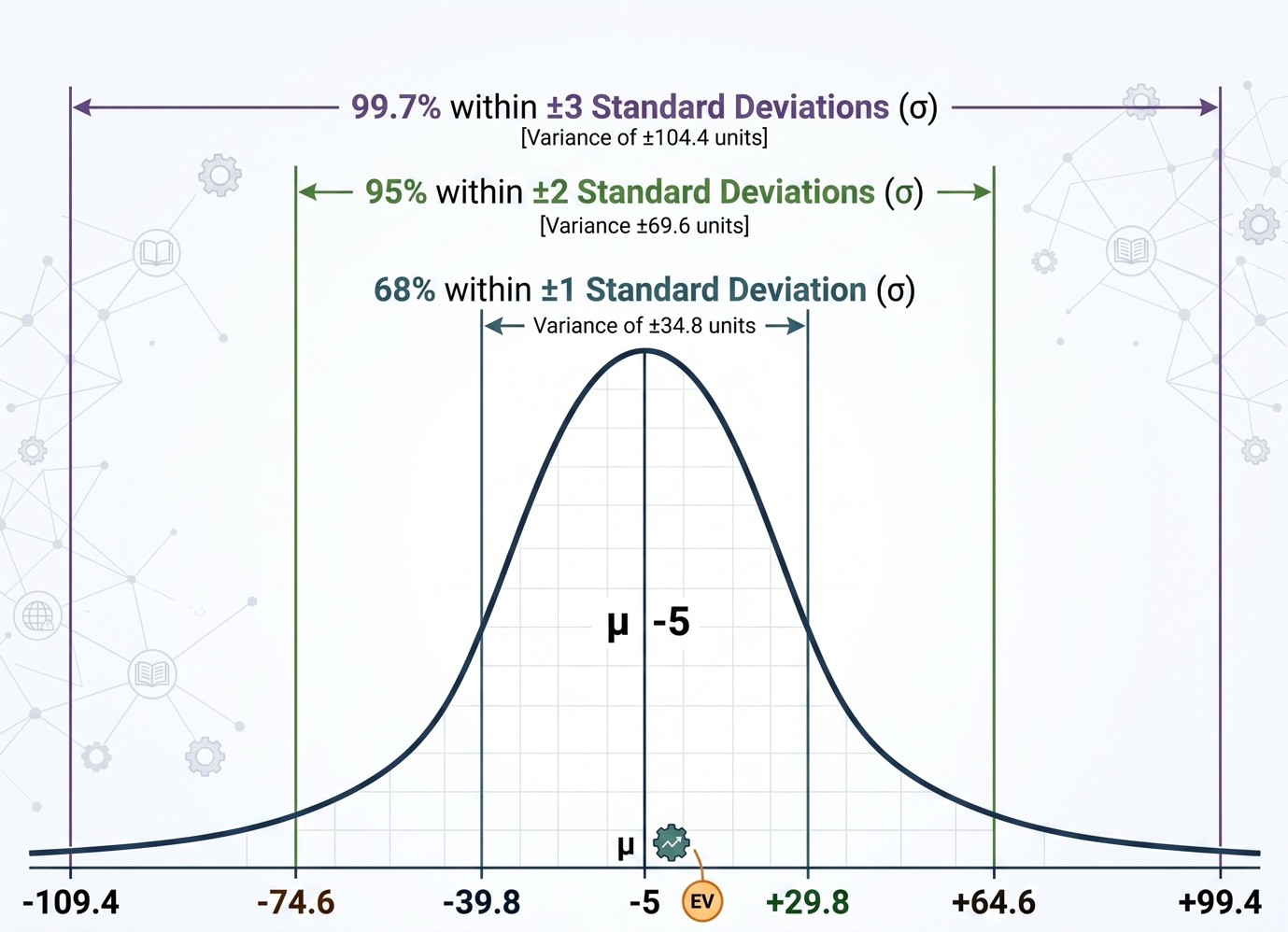
The distribution of outcomes over a thousand hands of basic-strategy blackjack: mean −5 units, standard deviation 34.8 units.
When we multiply that by two to find our 95% confidence interval, it translates into a massive swing: 95% of players will leave the casino with a sum comprised between -74.6 units and +64.6 units.
Despite the tiny 0.5% house edge, a player at a €4 table could easily find themselves up €258 or down €298 after a long evening of play.
I've been on the far right of that curve a handful of times. A lot more often in the left-hand side: you can lose it all quite rapidly when your bankroll is not aligned with the wager! In theory, only 45% of the advanced blackjack players leave the casino with a positive outcome.
Not convinced? Considering a mean of -5 units and a standard deviation of 34.8 units, we have:
I insist on advanced players and on in theory: reality is harsher!
The law of large numbers is the casino's business model, not yours
A casino runs millions of hands a year. A player can only run a few thousands a year, with a finite bankroll. There is an obvious asymmetry: against an unlimited opponent, with a negative edge, the probability of eventual ruin goes to one. This is captured by the concept of Risk of Ruin.
Risk of Ruin is the statistical probability that your bankroll will hit zero before you achieve your financial goal (or over an infinite time horizon). It depends on the total bankroll (i.e. the capital dedicated to the game), the expected value (i.e. the edge against the house), and the variance or standard deviation (i.e. the volatility of the game). As we've just discussed, blackjack is a mathematically high volatility game. This is further enhanced by the massive variance introduced by the possibility to double down, split, and the 3 to 2 payout on a blackjack (ace + ten). Therefore, if the standard bet is too large relative to the total bankroll, a standard statistical downswing can wipe the player out in only a few hands.
The one place skill enters
If you've been reading carefully so far, you will have noted the recurrence of the notion of basic strategy at blackjack. As we briefly mentioned in the introduction, some games can be influenced by the player's actions.
The house edge is altered, sometimes even reduced near 0% should a player play a perfect game: in practice, it is almost impossible.
Blackjack: the game you can study
The rules, in one pass
As the table above shows, blackjack is the game where the casino has the lowest advantage over you. The good thing with blackjack is that you can learn and train by yourself. This is not a game you play against other players, but against the casino. For those who do not know the rules at all, you're dealt two initial cards, as are the other players at the table, and you must try to get 21, but never more, by either standing on these two starting cards or hitting more, meaning asking the dealer to deal more cards, one at a time. If you go beyond 21, you've lost. If you stand at or below 21, your fate is in the hands of the dealer, who will also play to get 21, but in a very strict way: they will hit cards until their count reaches at least 17, at which point they will either stand, or lose if beyond 21. Therefore, no need to have a friend to act as dealer: the dealer does not take any decision, it plays according to a known script. In terms of mechanics of the game, each player takes their turn, from the right to the left, finishing with the dealer.
Assuming your count does not exceed 21, your win is dependent on whether the dealer beats your count or not. As simple as that. As I do not intend to write a full tutorial, you can get a complete grasp of the game by watching the explanatory video from Blackjack Apprenticeship on How to Play (and Win) at Blackjack, which teaches the various rules of the game in far more detail, and in a more instructive way.
Before you sit down
Now that you're familiar with the rules and have played a few hands at home, don't rush into a casino, as tempting as it is. First, because there are a few more things you need to understand before playing in real conditions. Starting with the actions you're allowed to make, beyond standing and hitting. A couple more make the whole game a lot more dynamic: you can split your game as well as double. And in some versions, you can also surrender. We will spend more time on these actions in the strategy section.
Second, because spending time at a real table can be a little stressful at first, and you will be more at ease if you're very clear on how to play, what action to make, and when. It is one of the reasons why choosing your casino well is important: not all casinos are beginner-friendly. By experience, the fancier the casino is, the more experienced the other players will be, and the less patient they will be with newbies. Naturally, this is not a general rule: I've also met very friendly players who were very patient and even gave me some tips on how to play better.
The best experience is however in smaller casinos, on a night where only one or two players are sitting at your table, if any. Dealers are usually more than happy in such settings to take the time to explain the rules to you again, how to play in a casino, the basic strategy, and so on. Even at busier tables, it is part of their job, so you can rely on them if you feel lost. But they will have less time to spend with you on strategy or casino rules.
Every casino plays a different game
Because yes, each casino has its own version of blackjack (classic, European, Atlantic City, Vegas Strip, Spanish 21, Pontoon, etc.), each coming with its own set of rules (usually similar for the key rules, but the devil is in the detail). There are versions that are more frequent than some others, typically European and American (either Atlantic City or Vegas Strip). The main differences between these two versions are summarised in the table below:
| European Blackjack | American Blackjack |
|---|---|
| Dealer does not have a "hole card" | Dealer receives a "hole card" and can check for blackjack |
| Players can only double down with hard totals of 9, 10 or 11 (exception in some games) | Option to double down in all scenarios |
| Players can only split once | Players can split up to three times |
| No option to surrender | Option to surrender |
The set described in the above table is the online variant of European blackjack, which is closer to UK land-based practice.
As a matter of fact, in most of the casinos I've played in France (sample of six, so would not call that a study either), I could actually double down on any total and split up to three times. The simple explanation to that is the law. French blackjack is governed by the arrêté du 14 mai 2007, articles 55-4 and 55-5: doubling is permitted on any two-card total. Besides, re-splitting is expressly contemplated, with a third split at some houses; and "abandon" (surrender) exists at each casino's discretion.
Again, each casino has its own rules. Familiarise yourself with your local casino's rules by spending a bit of time around the table, watching other players. You will not only learn the rules, but also spot the more advanced players, who are not always the ones betting the most, and learn from their hands.
A note on etiquette
A brief note on casino etiquette, before moving to the strategy itself, as it will help you being at ease. During a game, players barely talk (not that it is forbidden): hands are signalling their intent. Tapping to hit, waving horizontally to stand, placing a second chip next to the first to split or double. That last one is important: you never touch the cards. These formal and informal rules are easy to remember and, again, watching a few games without playing will teach you all you need to know about that. Another thing to know before taking a seat at the table: you do not hand money directly to the dealer. The cash is laid on the table for the dealer to change into chips. This seems odd but it prevents dealer/player collusion, helps in case of dispute (keep in mind that there are cameras recording every instant and angles of a table), but also ensures a flawless audit trail (important as casinos are highly regulated!).
Basic strategy: the non-optional step
Which brings us to the core of your learning: the basic strategy. This is the actual name of that strategy, because these are the basic rules you shall learn to play the statistically best move in every possible situation. By sticking to this strategy, you're optimising your odds to win over the long term.
The method is very simple: it tells you when to hit and when to stand, but also when to double down or split. It has nothing to do with counting cards here. It is basic probabilities applied to your cards and the one you can see from the dealer. This is not an optional step if you intend to play more than occasionally. In theory, playing according to what the probabilities say reduces the house's edge for the player in comparison to the one playing with no strategy at all.
This edge has been computed, and it varies with the version you play. As I've only played in Europe so far, I will generally stick to the numbers most associated with the European version of the game. If not, I will mention it. Wizard of Odds puts basic-strategy house edge at 0.62% (assuming: six decks, S17, double 9–11 only, DAS, no hole card, no surrender). This compares to 5.48% if you mimic the dealer's strategy (in other words, playing like an algorithm): 13 times worse and you can check how bad an idea it is in this video from Blackjack Apprenticeship!
The basic strategy lowers the house's edge to 0.62%. This means that you're still losing money, just at a slightly slower rate.
Please, keep that in mind throughout this article.
Before starting your learning journey of the basic strategy, you must check the version of the game you will be playing. The European version in particular is played out of 6 to 8 decks in the shoe, with a soft 17 (S17) rule (meaning the dealer stands on a combination made of an ace and a six), a payout of 3 to 2 on blackjack, the option to purchase insurance if the dealer shows an ace (generally not recommended), the dealer receiving only one card face up, no possibility to surrender, but possible to double, even after having split your cards.
It is then easy to get accustomed to the strategy: it requires learning by heart all the various combinations of your count against the dealer's, and what to do accordingly. A good intro to it can be found in the video published by, again, Blackjack Apprenticeship and available here. It is also well explained in the book Blackjack Attack by Schlesinger or Wizard of Odds' strategy pages for the charts.
The flashcards
These rules are easy to learn using flashcards. I personally rely on Anki, a free spaced-repetition app used by many to memorise anything (often languages): the interface is very basic, which makes it easy to use, and the app is highly customisable, including the loading of any ".apkg" files with your own flashcards. I could not find a set of flashcards to learn the basic strategy for a European game. I created my own a while ago, available for download here: the ENHC (European) deck and the OBO (UK) deck. The core parameters for these flashcards:
True ENHC flashcards strategy set
-
6 decks
-
Dealer stands on soft 17 (S17) — not H17
-
Blackjack pays 3:2 — not 6:5
-
Double after split allowed (DAS)
-
Doubling on any two cards — including soft hands (but careful, I am aware that some French tables restrict doubling to hard 9/10/11, which would change the soft-total cards to "hit")
-
Split up to 3–4 hands; split Aces get one card each, no re-split
-
Insurance offered on a dealer Ace (and the deck's answer is: always decline)
-
No surrender baked into the core cards (surrender appears only as optional notes on hard 15/16, since it varies by house)
For my British friends, who are playing the Original Bets Only (OBO) version, a mathematically equivalent version to the "peek" American version, I asked Claude to create a set of flashcards on the back of my existing one. There are only three minor changes to the strategy versus the ENHC rules:
-
Hard 11 → double vs 2–10, hit only vs Ace
-
Pair of 8s → always split
-
Pair of Aces → always split
Where the mathematics stops
But don't be fooled by the basic strategy. While it makes a player feel more confident in their games, it does not guarantee any winnings. First, there is always the human factor: we may feel tempted to move away from the strategy on one hand or two. It requires discipline. Second, probabilities are what they are: the luck factor remains here. I recently played alongside my dad, who was not aware of the basic strategy and just plays for the fun of it. We both lost our entire stake: it just took me longer. That night, the dealer told me a few times that I had made the right choice and that they would have played the same way: mathematics can be right, but the cards can prove them wrong. This remains a game of chance.
Card counting: easy to learn, hard to use
So how did these MIT students manage to secure hundreds of thousands playing blackjack if that's mostly down to luck? They added another edge to their sleeve: card counting. Card counting is always viewed as a complex technique that can only be mastered by a handful of people. Nothing could be further from the truth! First, there are countless resources available to teach you how to count cards. Second, it does not have any prerequisite other than having a good short-term memory to remember the current count and very basic mathematical skills to add or subtract one to that count, when necessary.
What is however difficult is to do so rapidly, while keeping your focus on the other aspects of the game (i.e. the basic strategy we just discussed)... and all of that without getting caught!
Don Schlesinger, the author of Blackjack Attack, a reference book consolidating all the best articles he previously published for years, and for free, on Blackjack Forum, explains it very well: counting is easy, but counting discreetly is more important if you don't want to get banned. Otherwise, all that learning is useless: the life expectancy of your skills will be limited to a couple of sessions per casino at best.
One of the best videos I found to learn how to count cards comes once again from Blackjack Apprenticeship: How To Count Cards: It's Easier Than You'd Think. The video tackles the most popular counting method: High Card / Low Card, or Hi-Lo count in short.
Each card rank is assigned a value of 1, 0, or -1. Counting cards is then just a matter of adding the values of the cards being dealt: this is your running count. From there, getting the true count requires dividing that running count by the numbers of decks left in the sabot (or shoe) — no need to be precise, an approximation works well enough, you can round it up (or down).
There is no good or bad true count value per se: a player must either stick to the basic strategy or play according to the true count and a table of index numbers, depending on the hand. Having said that, a high true count shifts the mathematical edge away from the casino and toward the player, meaning you should increase your bet size. A negative count is objectively bad, meaning you should bet the table minimum or walk away.
Index numbers, the Illustrious 18 and the Fab 4
Let's come back on that concept of index numbers. The basic strategy assumes the deck is completely neutral, meaning it has a count of exactly zero: this is the starting position when all the decks are in the shoe, at the very beginning. As cards are dealt, the composition of the deck changes. Index numbers are specific true count thresholds that tell you exactly when the math shifts enough to justify abandoning basic strategy. If your true count is equal to or greater than the index number, execute the related deviation. If the count is lower than the index, stick purely to basic strategy.
To quote the Wizard of Odds: "The player should stand/double/split if the True Count equals or exceeds the Index Number, otherwise hit. The player should take insurance if the True Count is +3 or greater."
There are two tables to learn by heart to use index numbers. Both have been created by none other than the blackjack mathematician Don Schlesinger: Illustrious 18 and Fab 4 (only played when the table offers late surrender). They each represent the most mathematically profitable deviations from basic strategy. In theory, there are hundreds of possible index numbers for every hand combination. It would be a tremendous exercise to learn them all. Schlesinger proved that focusing on just these 22 specific plays captures the vast majority of the potential available. Typically, over 30% of the total profit gained from the Illustrious 18 comes from just the first play: taking Insurance at a true count of +3 in a six-deck game. If you memorise the next two plays (16 vs.10 and 15 vs. 10), it rises to 60%! And to over 90% with the top twelve plays: the Pareto principle at work.
While it appears simple to count cards and play accordingly, one must remember that the dealers are trained to spot card counting patterns. They equally know how to count cards, play the basic strategy, and use index numbers. Card counters must introduce some form of randomisation in their play to avoid getting spotted... which is detrimental to their profitability! In practice, professional counters often ignore plays #4, #5, and #6 on the Illustrious 18 (Splitting 10s and Doubling 10 vs 10). While mathematically correct at high counts, splitting 10s is widely considered the loudest alarm bell you can ring in a casino, and pit bosses are trained to spot it instantly.
Other counting systems
We've been into the details of the Hi-Lo counting method, but there are many others out there. For instance, the Knock-Out system, popularised in the 1990s by Olaf Vancura and Ken Fuchs in their famous aforementioned book, works exactly as per the Hi-Lo method to the exception of the card 7, which is assigned a +1 value (vs. 0 in the Hi-Lo system). This leads to an unbalanced deck (count of +4 per deck) and has the benefit of removing the necessity of calculating the true count, which is where most people struggle. The count now naturally drifts upward as more cards are dealt; therefore, the running count already factors in how deep you are into the shoe, which was the "estimated" piece required in the true count calculation.
Bet sizing: Risk of Ruin and the Kelly criterion
Now we have all the cards in our hand to play as a professional player, it is time to remind ourselves that blackjack presents massive swings or variance, as we've demonstrated in the first section. A player can do everything mathematically perfectly and still lose ten hands in a row, as I've experienced many times. Capital preservation thus becomes the primary constraint. Time to introduce the Kelly Criterion.
To avoid ruin, advanced players use the Kelly Criterion. This is a mathematical formula developed by Bell Labs researcher J.L. Kelly Jr in 1956, in the paper "A New Interpretation of Information Rate" (yes, the founding text of bet sizing is an information-theory paper about noisy channels!). It calculates the optimal percentage of your bankroll to wager on a single bet to maximise the long-term compound growth rate of your capital, while keeping the Risk of Ruin mathematically near zero.
In simpler terms, it answers the question "if you have an edge, how much of your capital should you risk on a single event?". If you bet too little, your capital grows too slowly, and you fail to capitalise on your mathematical edge. Conversely, if you bet too much, standard statistical variance will eventually trigger a drawdown severe enough you will end up ruined.
For a simple binary outcome, the formula is
Where:
-
= The fraction of the current bankroll to wager.
-
= The probability of winning.
-
= The proportion of the bet gained with a win (e.g., 1 for an even-money 1:1 payout).
But blackjack is not a simple game. Professionals therefore use an adapted formula focused on expected value and variance to account for the inherent volatility of blackjack, using the continuous version of Kelly Criterion:
Where:
-
EV = Your mathematical edge at a specific True Count
-
= The square of the standard deviation of the game's outcomes.
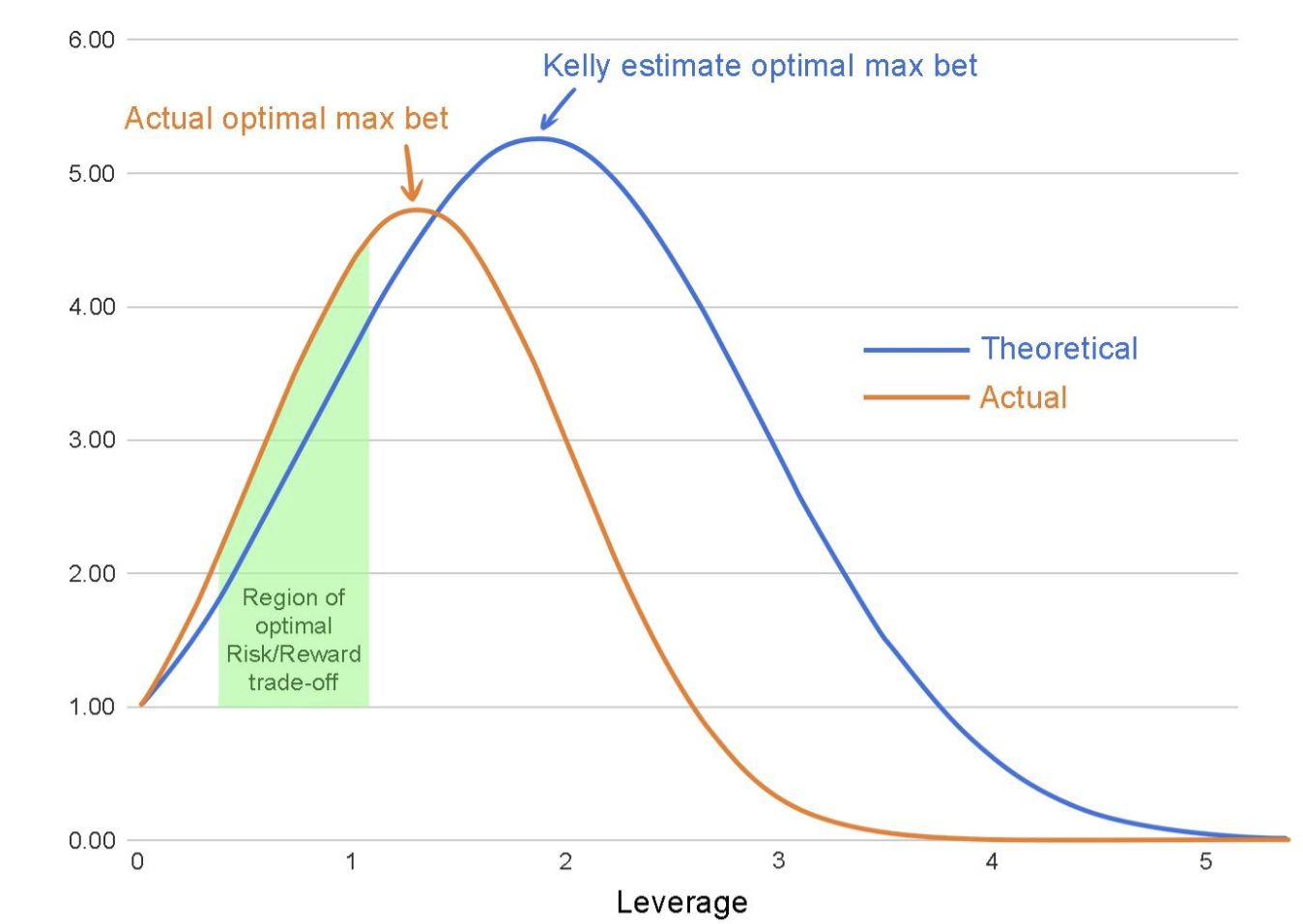
The Kelly curve: growth versus leverage. Source: Nick Yoder, The Kelly Criterion — Quantitative Trading.
While betting the exact percentage dictated by the formula, what is called a Full Kelly, mathematically guarantees the fastest possible growth, almost no professional player actually does it. Betting precisely at the top of the curve maximises growth, but betting even slightly past the peak pushes you down a cliff where growth turns negative, leading to certain ruin.
A player betting Full Kelly has a roughly 33% chance of seeing their bankroll halved before it doubles.
Most people simply do not have the psychological fortitude to endure a 50% drawdown in real cash.
To smooth out the variance, most advantage players bet "Fractional Kelly", typically Half-Kelly or Quarter-Kelly. By intentionally under-betting the optimal mathematical amount by 50%, they significantly reduce the volatility and practically eliminate your Risk of Ruin, at the cost of slower overall bankroll growth. Interestingly, the Kelly Criterion is also used by quantitative hedge funds. This is no different to what traders consider daily: they set a stop loss (= their Risk of Ruin) and size their position (= fractional Kelly).
These concepts are well explained in Blackjack Attack by Don Schlesinger. This is the definitive text on Risk of Ruin and optimal bet sizing in blackjack. If you want to go deeper and create your own structure of bet spread to maintain a specific Risk of Ruin, the QFIT Casino Vérité suite (CVBJ to practise, CVCX and CVData to simulate), created by Norman Wattenberger, is the gold standard for blackjack mathematics. You input your bankroll, the casino's specific rules, and your risk tolerance: it then simulates billions of hands to tell you exactly how to structure your bet spread.
This bet spread structure directly relates to the True Count. Depending on the value of True Count at a given moment, you will bet a given sum, calculated ahead of your casino session with the help of CVCX software (noting that you must round them to match standard casino chips, naturally!).
How the casino fought back
We have now established that blackjack is a great game where strategy can improve your odds and counting methods can meaningfully add to your edge. Does it mean there is a secret formula? I'm afraid that it is still a no. Especially given that, since the early 2000s, most casinos have adapted to the various card counting approaches. Many, if not most, are now equipped with continuous shuffling machine, or CSM. Commercialised around the turn of the 2000s, these machines are, as per their name, reshuffling the cards every time discarded cards are put back in. This ensures that the deck composition always remains almost neutral. There is therefore only a short window during which players can count, as not all discarded cards are put back straight away into the machine: this is called latency counting. But this minuscule edge is well documented and proves quasi useless. Is it therefore useful to learn these more advanced methods if it's to get only a marginal edge over the basic strategy? Arguably no.
However, there is a counter-intuitive mathematical quirk for basic strategy players: playing on a CSM actually lowers the house edge by a microscopic amount (about 0.028% for five decks, once again a figure from the Wizard of Odds). Because the cards are continuously replenished, the "clumping" effect of low cards that typically hurts players in a standard shoe is smoothed out: the CSM removes the cut-card effect. But it is a trap: the core reason of the adoption of that technology is not so much to counter card counters, but rather to increase speed: a CSM increases the number of hands dealt per hour as manual shuffling requires two to three minutes.
It is a relief that some casinos still operate without CSMs. I have a fond memory of a night at the casino in Ajaccio, where the dealer offered a purely old-school, manual experience. From my perspective, it was vastly more pleasant and entertaining, especially the ritual of handing a player the responsibility of placing the cut card into the deck. While manual shuffling undeniably slowed down the game, the downtime created a natural opportunity to chat with the dealer and the other players. It transformed the table from a gambling transaction into a genuinely social experience. Ironically, I didn't even capitalise on the manual shoe, as I never bothered learning to count cards: almost every other casino I have visited was already equipped with CSMs.
Playing the dealer, not the cards
Beyond counting cards, there are a few other approaches that could give you an edge. These approaches are rather physical and rely on either the dealer's skills or the table's geometry. It is indeed sometimes possible to catch a glimpse of the dealer's second hidden card. Yet, this is only applicable to non-European tables as the European version of the game dictates that this second card is not dealt at the beginning. It is however a possible edge in the US, where it has even been ruled legal so long as the player has only used their two eyes to gain that advantage: this is a ruling from the Nevada Supreme Court's Einbinder/Dalben in 1984. So instead of playing the cards per se, with counting methods, you play the human.
Poker: the game where you play the people
This makes the perfect transition to the next game: poker. Poker, just like blackjack, is a great game to play with a strategy driven by probabilities. It has one material difference, however: the players never play an algorithmic dealer; they rather play each other, each having their hand concealed.
There are no open hands, as there are in blackjack. This adds a psychological dimension to the game.
The game is famously known for the instances of bluffing. There are many videos showing how a player with no valuable cards at hand ended up winning the hand by using the weaknesses of their opponents.
Before jumping into the topic, a few precisions. Just like blackjack, there are many versions of poker. My focus for this article will be the most famous and played, Texas Hold'em. Why? Because it is the only one I have ever played, as simple as that. But also, because it is the one that Bastien plays, and he was kind enough to share his experience with me. As I mentioned in the intro, my own experience with poker is limited to friendly games and a couple of sessions in a casino. A couple of reasons for that. First, the casinos I visit the most had no table for poker — even though I understand from my last visit they may soon open one. Second, it is slower paced and being good at it, as we will see, requires a lot of work around the psychological aspects, both of which were less attractive to me. I have taken the opportunity of this article to educate myself on the topic though.
How Bastien started
The first question I had around the game, and maybe I should have asked myself that question a long time ago, is how do we learn how to play seriously? Bastien's journey was actually quite instructive. He started like most people: friendly games, to learn the rules. They are quite simple, but less than blackjack. Therefore, I will refrain from explaining them at length here and would sum it up as "getting or making believe you got the best combination of cards", where combinations can range from a pair, two pair, three of a kind, a straight, a flush, a full house, four of a kind, a straight flush, all the way up to the legendary Royal Flush. In that very specific order, this is the absolute baseline of the game. The mechanics of the game can be learnt in depth on the very instructive channel of PokerNews, and their Poker for Beginners video series
The other important thing to learn, if you want to progress at least, is the vocabulary. While I had played a few dozens of hands in my life, I started writing this article with very limited knowledge of the actual words used in the various books, articles, videos, or podcasts I consulted during the writing. This made my life a lot harder. While I cannot define every single term related to poker in this article without making it too boring and long, a few definitions are worth highlighting, as these terms will come back more than once.
Starting with the flop, which consists of the first three cards dealt and shared by all the players around the table. The fourth card to be revealed is the turn, and the final one is the river.
In terms of actions, you can either fold, meaning you abandon your hand and lose your current wager, raise, which is increasing the amount of the bet, call, or matching the current bet, check, in which case you kind of pass your turn by neither folding or raising if there is no need to call, or go all in, which I believe is self-explanatory.
We will discuss later the concepts of blinds and rake in more details. To be on tilt is to be emotionally unstable leading to erratic play and usually losing money. A tell is an unconscious gesture that reveals information about a player's hand. And finally, a bluff is the action of betting with a weak hand, with the intent to get other players to fold, out of fear.
Bastien quickly moved to online poker. Just like millions of other players, some casual, some professional. This is the best way to practice as much as possible as you will find players connected at any time, thanks to the magic of the internet. Timing to get into such regular practice is however key. Bastien is honest:
A note on the quotes that follow. Bastien and I spoke in French, and the translations are mine. I have kept them close to the way he actually said things rather than smoothing them into polished English, so where a turn of phrase sounds slightly odd, that is him and not a slip.
"I made a €20 deposit on an online poker platform. Obviously, it was way too early and I had not learnt what I should have learnt by then. I lost it all in two to three weeks. As simple as that."
— Bastien
Choosing a format
Because the second thing to learn about poker is the different game formats. The choice of a format is anything but trivial, as it defines the strategy. Cash games are where a player deposits an amount at a table and plays as long as they want. Tournaments are the media-friendly format, with large cash prizes, lasting four to six hours on average. And finally, the spin and go game is to poker what espresso is to coffee: a quicker version of the game, up to 10 minutes, with three players competing. The latter is usually the one where players start their journey: you don't need to invest too much time into the practice, you learn on the go, and eventually, once you feel you're plateauing, you start investing in your learning curve rather than your bankroll.
Which is what happened to Bastien: after a lot of ups and downs, but always playing casually, he decided to invest in a training course to improve. This decision marked a turning point in his journey toward more serious play.
The mental game comes first
Most of the training courses you can find online, whether free or paid, are focusing from almost the very beginning on the importance of the mental. Typically, the book The Mental Game of Poker by Jared Tendler is considered by the poker community as mandatory reading: the author applies sport psychology to poker, providing a systematic framework for identifying and fixing what we call "tilt", or in normal vocabulary, emotional collapse, but also fear and lack of focus. It naturally addresses bankroll preservation. The podcast Chasing Poker Greatness, hosted by Brad Wilson but on hold for a year now, is another excellent resource on the habits and mental frameworks to succeed at poker, including bankroll management, dealing with variance, or the psychological fortitude required.
I got curious and watched a few interviews from professional players. All state that after learning the jargon, you must study the mental aspect of the game. The mental game is the risk management framework that prevents a catastrophic blowout. Bastien confirmed: the first section of his paid training was entirely dedicated to the mental aspect of the game rather than the technical aspect.
"How to articulate your life around the game depending on your goals, whether you want to spend 50 hours or 10 hours a week. But also, how to avoid getting addicted."
— Bastien
Moving up, and moving back down
This paid off for him. He started playing on micro-stake tables, playing 20 cents at first, moving into higher stakes step by step, aligned with his progress. He noticed that his relative level declined at each step: you're playing against better players, just like in any video game. The biggest step he encountered was once he tried a table with a €10 blind: some pros are playing at that type of tables resulting in a much stronger level. It did not go well for Bastien: he just consciously decided to go back to a smaller blind.
"I started with a couple of thousand euros. I told myself: if I go down to €1,500, I will look at my stats, and if they are not good, I will just go down in limit. There is no ego to account for. Even if we're getting better, we can still lose often."
— Bastien
Just like with blackjack, we can follow the lines of the perfect strategy, and I am aware we haven't even outlined any of that yet, and lose every single hand over a long period of time. The variance will make its job and can wipe out even the best players if they stop following their own rules, especially the ones around bankroll management.
What the professionals say
Pro player Pierre Calamusa summarised it very well in an interview for the online media Legend. Beginners often confuse a lucky streak with actual skill. When the inevitable bad run hits, the biggest mistake is moving up in stakes to chase losses instead of focusing purely on decision-making quality. He insists on that fact that professionals make the overwhelming majority of decisions on autopilot, leaving conscious effort for the handful of spots that matter.
It is therefore worth spending time, once we reach a good level, studying decisions made by pro players. Most tournaments now being broadcast, many poker aficionados are now producing content around them, including deep dives into specific hands. As Bastien learnt from the webinars of another paid training, I found a couple of free, yet highly praised in the community, playlists. You can have a look at the series Inside the Mind of a Pro, a series offered by the betting website Winamax (not sponsoring this article), or to Crush Live Call-Ins on the CrushlivePoker channel, hosted by Bart Hanson. Both aim to explain the decision-making process behind each hand.
The rake: why poker is not zero-sum
Poker is often defined as a zero-sum game. If you play at home, with your friends, then it is. Whatever leaves your pocket will go in the one of the other players. So technically, yes. This stops being true from the moment you put a foot in a casino, whether online or physical.
Casinos are earning what we call the rake: this is a percentage of every cash pot or entry fee. Online casinos typically take 3 to 5% of the pot, with a cap. It was reported that GGPoker takes 4.44%, PokerStars international 3.65%, and WPT Global 3.06%. Live games are usually even more expensive, which isn't surprising as fixed costs are higher. A live game can see as much as 10% of the pot taken in $1 increments, with, once again, a cap ($5-7 in Las Vegas rooms). I read about some tournaments charging as much as 30% in rake! Red Chip Poker documents Las Vegas dailies at roughly $80 buy-in with $25 of juice, about 31%, and notes that below roughly $150 buy-in "it is doubtful that a tourney superstar could turn a positive ROI." And European operators often take a further 2–10% out of the prize pool on top of the entry fee.
This seems small, but with the number of hands played, it can quickly ramp up to $150-180 per hour per table (assuming a $1/$2 table). For perspective, a strong player would have a realistic win rate of c. $20 per hour: the casino takes in several times what the best player at the table earns!
About 30% of tracked online players beat the rake over samples of 10,000+ hands, and perhaps 15% over a lifetime once you count the people who quit during a downswing. Most players who are better than the table are still net losers. Therefore, if you are a beginner, try to find a casino offering a no-rake promotion or a rakeback deal (same concept as cashback).
Therefore, if poker is a zero-sum game, casinos have turned it into a negative-sum game with the rake. It would however be utopian to expect a service provided for free: casinos are not charity.
Position and pre-flop ranges: the first real skill
In a cash game, up to nine players will be competing with each other. Unlike blackjack, the position of a player has an influence on the strategy. This also means that the positions are not static: it turns clockwise. If you've played at least once, you are familiar with the concept of small and big blinds. For the reader with no prior knowledge of the game, this concept is driving the entire game as it forces two players to put money into the pot before seeing the cards.
It instantly creates an incentive for everyone else at the table. Indeed, without blinds, the mathematically optimal strategy for every player would be to fold 100% of the hands unless they were dealt a strong hand: there would be no cost of sitting and waiting. This is also where the bluff originates: the two players having paid either the small blind for the first, or the big blind for the second, are incentivised to bluff their way through in case of a poor hand.
Your position at the table is therefore key. The last position, which sits to the right of the small blind, is widely considered as the optimal one and is called the Button (or the dealer position). It is the best seat at the table because the player acts last on every post-flop betting round. The other three positions, beyond the Button and the Blinds, are the Cut-off (late position, as right before the Button), the Under the Gun or UTG in short (who sits right after the big blind), and finally the Middle positions.
Players will not play the same hand the same way whether they sit in an early position or in a late position. In case of early position, they tend to play tighter, meaning they will favour a fold over a semi-strong hand. Whereas a player sitting in UTG is likely to check that same hand. Which brings us to the pre-flop: that first phase of the game, where the flop is yet to be revealed.
Bastien is extremely clear: the technical work must revolve around the pre-flop. Just like with the basic strategy at blackjack, players must learn by heart when to fold, check or call, or raise, depending on their position and their hand. There is however a massive difference to basic strategy: one must also play the human, not just the probabilities.
Furthermore, there are a lot more combinations, called ranges, than in blackjack, as the latter does not care for suits. This also means you need to learn a standard notation to be able to read the grids. You can find such pre-flop charts for free (in exchange for your email, and only covering cash games and tournaments, not spin and go) on Upswing Poker, similar to the one reproduced below:
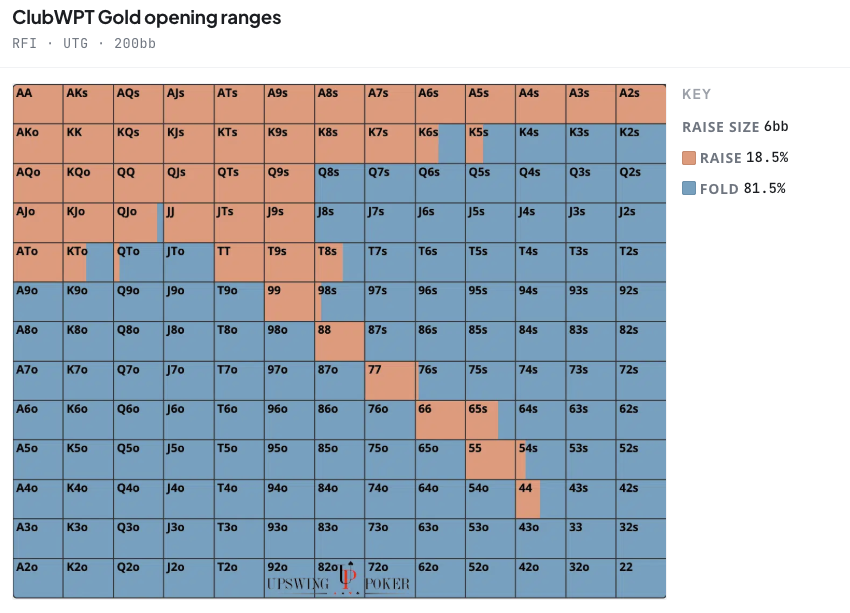
A pre-flop range chart: which starting hands to play, from which position, and how.
Make sure to check the format you are playing before memorising a chart... and relentless practice will be your best friend to make sure these cheat sheets remain forever anchored in your memory.
Pot odds, equity and outs: the arithmetic
Now you know how to play the pre-flop, even though I gave you an extremely simplified vision of that part of the game, it is time to think about the next stage: when the flop starts its reveal. The first mechanic to understand relates to the out cards. An out card, or out for short, is any unseen card remaining in the deck that will improve a hand. If you hold two hearts and the board shows two hearts, you are one heart away from a flush. Each suit comprising 13 cards, there are 9 hearts left in the remaining unseen cards, said another way, 9 outs. They can either be in the deck or in the hands of your competition.
It is now time to bring maths to the table. Mathematics help poker players to make better, or should I rather say, profitable over the long term, decisions in a context of uncertainty. Keep this in mind: poker is played over the long term, not hand by hand.
Let's start with the easy maths. There is an effortless way to calculate the approximate probability of hitting one of those outs: the Rule of 2 and 4. If only the river remains to come, then we multiply the outs by 2 only, meaning an 18% chance of hitting a heart. See for yourself:
Every single hidden card has a probability of 1/46, or ≈ 2.17%, to come next. If you have 9 outs, it means 9 * 2.17% ≈ 19.57%: the rule of 2 (18%) understates by about 1.6 points.
If only the flop is revealed, two more cards (the turn and the river) are yet to come: we multiply the outs by 4, and we get the probability to hit one of those outs. In our previous example, it would mean 4 * 9 outs = 36%. Again, mathematically speaking:
If you replace O by 9, you get:
Again, 36% was a good approximation, for something to calculate live, under pressure. The Rule of 4 works best for a number of outs less or equal to 8. Beyond that, professional players tend to use a sub-rule where they subtract from the original calculation the number of outs above 8.
This brings us to the notion of pot odds, or said in more normal words, the price of the trade. It calculates the ratio of the total money in the pot compared to the cost required to call a bet.
Typically, if a player raises €50 and brings the pot to €150, it costs you €50 to call the bet, hence a pot odd of 3 to 1. Many beginners prefer to reason in terms of break-even percentage, making it much easier to compare with the Rule of 2 and 4. It is calculated as follows:
If the required equity is lower than the outcome of the Rule of 2 and 4, it is a good call: over the long term, it would be profitable.
If not, just fold (unless you go for a bluff).
We can already note it is a lot more complex than blackjack. Well, it gets even harder as soon as we look at future expected value through the lenses of implied odds and reverse implied odds. These two concepts allow a player to adjust the baseline we just computed by forecasting future cash flows on subsequent betting rounds. When I first read about those, I assumed they were advanced concepts. It turns out they are part of the basics a player must learn to know when to play more aggressively, while preventing bankruptcy.
I can understand why people enjoy so much this game. There are so many things to factor in at every single step.
Before I start explaining these new types of odds, I think it is a good time to introduce the book that came back the most whenever I looked for resources to progress. Published in 1987, The Theory of Poker by David Sklansky is widely reputed for being the poker equivalent of the Bible. It teaches beginners, but also more advanced players, pretty much everything you need to know about the game in around 300 dense pages. This will be my reference for the next few paragraphs, starting with implied odds.
"There are times when the existence of future bets is the very reason you play a hand."
— David Sklansky
Implied odds basically look at what the future pot will look like by the river and therefore measure the additional capital you project to extract from your opponents if you hit your out. This last part is very important: implied odds are compared to the probability to hit the out(s) you need to complete your combination.
In practice, if you come to believe your opponent has a strong hand, on top of a lot of money, you assume they will continue betting heavily on the turn and the river. You make an educated guess on the additional amount they will pour into the pot... meaning you cannot pursue this strategy if you don't know your opponent! And if it did not feel hard enough, you also need to assess how hidden your hand is i.e. whether or not your opponents will call your bets. But also estimate your opponents' skills: are they strong players or weak ones? Weak ones are more likely to call, as less able to understand the concept of implied odds.
Conversely, reverse implied odds are signals that "your odds are not as good as they seem", once again quoting The Theory of Poker. This is particularly true when the opponent is controlling the betting while you hold an average hand, with limited chances to improve it. It tells you the cost of continuing a play versus the potential winnings: how much more are you likely to lose is the question you're trying to answer, using a similar thought process as for the implied odds, but when a situation is less favourable.
Before closing this section, I would like to recommend an excellent video from the channel GTO4OMC, Poker Math Made Simple — Equity, Pot Odds, EV and More!. Fun fact, OMC stands for Old Man Coffee, a term used to describe an older player who plays a tight, passive, and conservative style. I found it particularly instructive and a lot more concrete after reading the relevant chapters around pot odds and implied and reverse implied odds of The Theory of Poker. A couple of takeaways from Chris in this video:
-
Bluff is a balancing act: when you bluff with large bets, you need a higher rate of success if you want it to be mathematically optimal... but bigger bets also tend to create more folds. This is a balancing act, as he says!
-
You can make the right call and lose: this is normal. However, be careful not to celebrate lucky successes: when you made the bad call yet won. You did not play well and over the long term, it will make you lose money.
GTO versus exploitative
This brings us to the notion of Game Theory Optimal (GTO), a modern approach to poker based on game theory. Game theory is a branch of mathematics and economy, which models strategic interactions by analysing the decisions of rational agents whose choices and decisions are mutually impactful. It allows economic actors to forecast outcomes of cooperative or competitive scenarios, with the concept of Nash Equilibrium at the heart of the theory. Therefore, it is no surprise to see it applied in poker, where all players are competing for the same pot.
GTO is to poker what basic strategy is to blackjack: the most optimal way to play your cards, as if you were a computer. GTO does not require you to "read" your opponent or adapt to their style. It is entirely focused on constructing ranges and bet sizes that make the opponent's decisions mathematically irrelevant. GTO players' goal is to become unexploitable.
This means that a player must not play in a predictable manner. To the contrary, breaking patterns is the key for GTO to be efficient. This could mean either mixing raising, calling and checking, or mixing bet sizes, or playing weaker hands from time to time, or even folding on stronger ones.
GTO is often pictured as the opposite of exploitative play, because it does not seek to maximise profits against bad players. It is a rather defensive gameplay, guaranteeing that even the best players at the table cannot exploit you. Exploitative play is aggressive in comparison: you adapt to the opponents. It tells you to bluff more if you notice that an amateur opponent folds too often. It also means your game becomes unbalanced and therefore exploitable by a GTO player.
Professionals have pushed GTO to its limits. Calamusa confirms that pro players are studying thousands of hands with the assistance of GTO solvers. These are software tools that calculate the most mathematically optimal action for any given situation. We're far away from the fantasy world of poker players living the life of rockstars. Performing in poker requires good sleep, a healthy lifestyle, and a clear mind. Just like pro footballers.
Therefore, for a long time, algorithmic software stood no chance to win against pro players: they played too predictably. With the improvement in AI, new software finally got the best out of professionals. In 2017, Libratus, an AI developed by the PhD student Noam Brown and his professor Tuomas Sandholm from Carnegie Mellon University (CMU), finally defeated the world's best professional poker players during a heads-up no-limit exhibition with four pros called "Brain vs. Artificial Intelligence: Upping the Ante". The conclusion of the head of CMU's Computer Science Department is crystal clear: "The computer cannot win at poker if it cannot bluff".
A couple of years later, the same team, this time in partnership with Facebook (as it was still called at the time) as Brown joined the group, created Pluribus, the first superhuman AI to win against real humans at a six-player no-limit Hold'em. This was in 2019: we did not have the powerful AI models we now all use daily.
Such bots are now a commodity, and GTO solvers are now widely available. The most famous and also undisputed market leader is GTO Wizard, which directly runs in the browser. It however assumes solver literacy, and, having tried it, it is not that intuitive. Besides, at a cost starting at $49 a month, or $39 on annual billing (the free tier is capped at ten trainer hands plus one post-flop solution a day), it is arguably more for advanced players. My stats, shown below, are not catastrophic for someone with very limited knowledge of the game, but also reckon this is over a limited number of played hands.
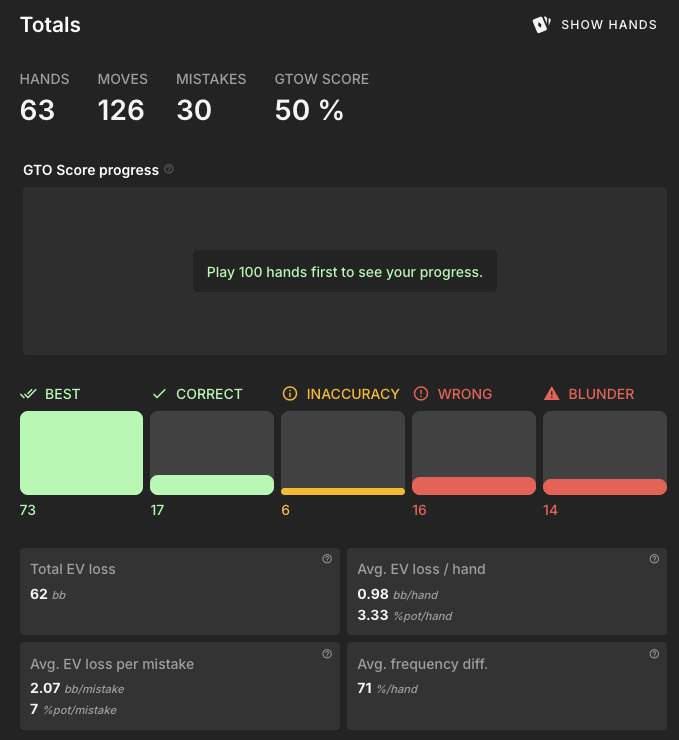
My own GTO Wizard statistics, over a deliberately small number of hands.
Competition includes GTO Lab and HoldemResources Calculator. If you prefer a one-off upfront cost to a subscription, look at PioSOLVER, whose new solving algorithm, as fresh as July 2026, is much faster. A free evaluation version is made available to players, with the same performance as the pro version, but with a core limit: it allows to solve only two example flops. In all honesty, I could not test it as only available on Windows. You can find on GitHub some open-source solvers, such as WASM Postflop (unmaintained, though it still runs).
I naturally questioned whether it could be a good idea to run a GTO solver next to an online poker session. Well, it turns out that it is classified as cheating and strictly prohibited by many major online poker platforms. Zero tolerance is given to real-time assistance and most platforms have invested in game integrity: they track any software running on your machine, decision timing, and use proprietary algorithm to flag accounts that execute too well GTO strategy. Because once again, playing perfect GTO is theoretical: only machines can do so!
Does it mean that the field is fully professionalised and it makes no longer sense to play poker? I suspect not. Most casual players won't either have the ability or willingness to put in the work to study GTO to the point they become hard to beat. Bastien's track record seems to tell the same story: he went from 20-cent blinds to €10 blinds while holding down his studies. A long way from professional, but a long way from where he started, and he got there on evenings and weekends. As many casual players only play for the fun of it, without ever trying hard to materially improve, the door remains open.
Bankroll management
Just like for any other game involving money, bankroll management is a fundamental of the game of poker. You won't be surprised to find a model similar to the one we described extensively in the blackjack section: the Risk of Ruin model. The excellent book The Mathematics of Poker by Bill Chen and Jerrod Ankenman goes into the details of the quantitative side of the game and provides the maths behind Risk of Ruin. It was by far my most enjoyable poker read (spoiler: I did not read it cover to cover) on poker, because it lays down the maths. I will steal some of their inputs for this section, starting with the risk of ruin function:
where is the risk of ruin constant, x the number of units of bankroll.
To find , we need to do some approximations. First, if we consider a game with a normal distribution, this results in:
where is the mean of that normal distribution, and its standard deviation.
But poker is not a normally distributed game! We're going, just like for blackjack, to use the Central Limit Theorem. As a reminder, it stipulates that distribution of samples of sufficient size converges on normal. This is not too bad of an approximation for a limit poker game, but does not work with tournament because of the winner taking it all (or a handful of players taking it all) and everyone else losing their entry fee. The book goes into that level of details, yes.
Chen and Ankenman looked at a "distribution of hand outcomes, which, while simplified, is not too far away from what we might find for a typical mildly successful player", their words not mine. This distribution has a mean of 0.02 and a variance of 10.80. Solving the above equation (2) for 300 small bets, we find and an associated Risk of Ruin of 32.89%. And now using equation (1), the Risk of Ruin of a 300-unit bankroll with this value of is 32.17%: this is close to our first result. Now, this works badly for small bankrolls, which is the main criticism from UCLA professor Rick Schoenberg.
I will stop here with the maths. The book also contemplates the scenario of no-limit ring games, using here again a normal distribution.
The above does not account for a key factor: the win rate. While a player's standard deviation will, over the long term, converge on the population standard deviation quite quickly, we cannot say the same for the win rate: it does not converge to the mean of the normal distribution we considered earlier, assumed to be the one of the true population. Applying our previous concept at the player's level, for any particular win rate:
where is the player's win rate, the bankroll, and its standard deviation per hand.
There is uncertainty around the win rate. The standard error of the win rate observation is:
where N is the number of played hands.
This leads, after complex considerations I cannot realistically transcribe here, to a Risk of Ruin under Uncertainty, or RoRU, illustrated below:
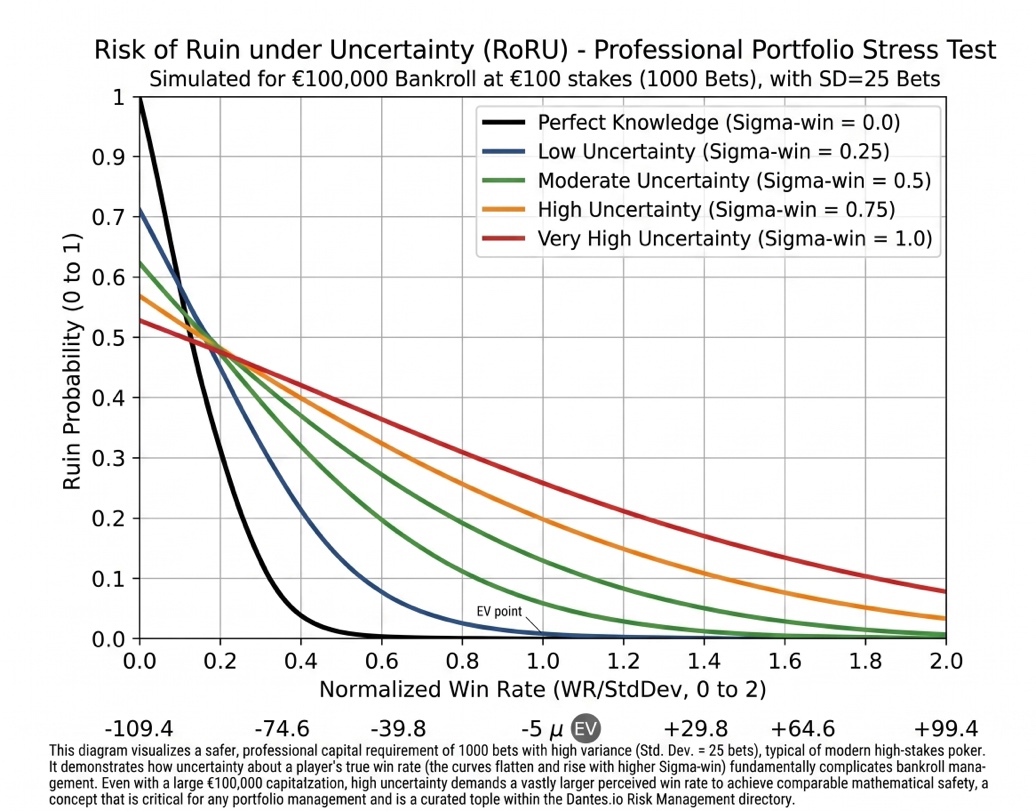
Risk of Ruin under Uncertainty: how uncertainty about your true win rate flattens and lifts the ruin curve.
All of this needs to be considered a bit differently for professional poker players.
The professional reality
Professional players are usually paying taxes on their winnings. This has an impact on the win rate: it brings it down by the tax rate. Calamusa estimates his lifetime winnings at roughly $3 million, gross. From which you must deduct heavy taxes, around €30,000 per year in coaching (again, this is like a professional athlete!), and spending on hotels and travel.
The authors of The Mathematics of Poker argue that the win rate must be taken into consideration after all the above expenses. Otherwise, most of the profit is directed towards lifestyle with no consideration for the implied impact on the Risk of Ruin, leading many pros to go broke after material negative swings.
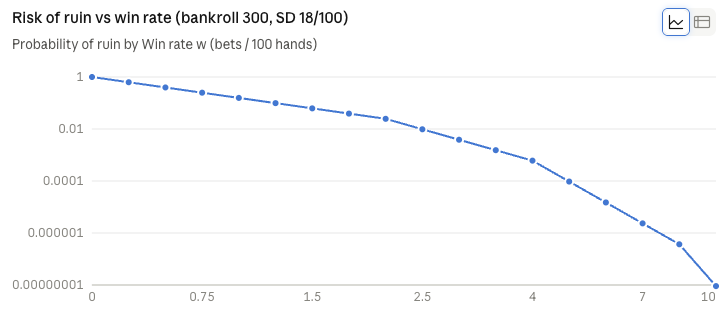
Risk of ruin against win rate, for a 300-bet bankroll with a standard deviation of 18 bets per 100 hands.
Assuming a standard deviation of 18 bets per 100 hands and a bankroll equivalent to 300 bets, a player must sustain a theoretical win rate of at least 2.5 bets per 100 hands to suppress the Risk of Ruin to the strict 1% threshold commonly required for professional capital management.
Again, the win rate is estimated, not known. Over a thousand blocks of 100 hands, the standard error on the win rate, in such configuration, is 18/√1000 ≈ 0.57 bets/100 hands, thus wider than the entire gap between "5% ruin" and "50% ruin". The uncertainty in the win rate dominates the curve. Now, let's also remember that most people stop playing well before they hit zero. But for professionals, it has a severe consequence: they cannot know their own edge well enough to properly size their bankroll from it.
A guinea pig
I've been reading for hours and watching many videos to be able to write something intelligible and, I hope, relatively complete on a game I had limited knowledge at the start. I thought it could be fun to run a trial over a bank holiday weekend, starting with £20, playing at 2c/4c tables, on limit cash games. I won't play a dozen of hours as I have other plans. But I will give it a fair go.
I have no positive expectation: I believe I will not be good at all, despite what the few stats I recorded on GTO Wizard could lead me to believe.
Writing this article convinced me that the game is a lot more complex than I had assumed. Besides, learning how to play is very different from learning about the game, even though some parts are alike.
For this experience, I will use pre-flop charts open next to me. I will also try to make good use of the Rule of 2 and 4: while it is easy to calculate, I am less convinced on my ability to compare it quickly enough to my pot odds. The next paragraph will be the conclusion of this article: my feedback after a weekend of poker.
The close
I spent a few hours playing poker over the weekend. I eventually chose the platform based on the bonus they were offering for new joiners. Combined with a table at 2c/4c small/big blinds, it allowed me to play comfortably without spending my own money. This proved to be wise: I don't want to spoil the ending, but the €8 bonus I received was all lost.
This was my cue to go: I did not have the level to compete, even at small tables.
How did I end up losing it all? I tried to play as per charts for pre-flop. I think I succeeded quite well with that part actually. But I got carried away with the stages after. In the heat of the moment, I found it difficult to calculate odds, even with the Rule of 2 and 4. The first difficulty came from identifying my outs: I was not quick enough to think of possible combinations. This clearly does not help the calculations. I guess this part is a matter of habit. I may have been quick enough to compute the pot odds only a dozen times or so, if I had to make an estimate.
I tried to have a go at implied odds. Not in the formal sense of it, given I was barely calculating my pot odds anyway. But rather in terms of strategic thinking: which player is likely to call my bets and how to size such raises to not scare them. This part worked relatively well somehow. Not always: along the way I lost players I thought would call, but also lost some hands as my outs did not materialise during the post-flop.
These losses are the ones that led me straight to bankruptcy. I took sizeable losses by raising too high and being called. Yet, this did not lead me to think in terms of reverse implied odds. Playing aggressively to force folds was simply the style of a couple of players at the table. I was tempted a few times to call their bets as I had a relatively good hand. By thinking in terms of probability to lose that hand in perspective of the amount to call, I ended up folding a lot more than I would have intuitively done. Yet again, not always.
I grew confident at some point when we were only three or four playing at the table, against the usual six players. It allowed me to spend more time identifying the patterns of my opponents. Two types of players proved profitable to me. The first type was very tight and could be pushed into folding by raising high enough. I took incremental steps to first assess their hand, and if no call from their end, I just raised my bet substantially to force them into a fold. I only did so when my hand was strong enough, but I did not play extra tight.
The other type was the exact opposite: they played most hands, raising during pre-flop with high stakes. I took the opposite approach to the one I took with the previous type. I played a lot tighter, and when I did not fold, I even raised. As I was describing earlier, I tried to reason in terms of implied odds to extract as many chips as possible from that type of players.
The strategy worked quite well and even led me once in a successful all-in situation. I was 50% up at one point in the game. Yes, two whole euros! I did enjoy that part of the game, because I was focused and made, overall, good decisions, even when they got me to lose. I could at least back my reasoning to play with GTO.
Two issues arose. The first one is that some players adapted to my game and started setting traps. I got caught a few times and because I had grown confident in my strategy and reading of my opponents, these losses hurt: I had called or raised way too high, which reverse implied odds would have neatly spotted.
The second issue is that I could not replicate it as soon as there were more than four players around the table, which was most of the time. Why that? First, I was not the only one to notice these patterns. I was quickly joined by other players who adopted the same strategy against my identified victim, and I had no idea how to react. I ended up not amending my strategy much, just folding a tiny bit more often. This however led to escalation: because I was no longer the only one raising, but also not the one with the largest bankroll, I became a target myself. Players noticed I was calling or raising often and started applying my own strategy against myself.
This is where I think patience is key. No need to be a pro player to realise that the best tactic to adopt is to go back to a tighter game and not exploit the potential of that weaker player. Playing very tight was too frustrating for me as I saw my bankroll going down with blinds and either no hand being played or folded very early on. It got under my skin and I tilted towards the end. I started acting a lot more irrationally. This paid off a handful of times, but this was pure luck. And I knew it. Once I had decided I had seen enough, I adopted an aggressive style, all the way to an unfortunate yet unsurprising all-in. At that point, I did not care much any longer, even less considering it was not my own money I was playing. I eventually never played any cent of my initial deposit and got it all back on my bank account, safe and sound.
More generally, the game is very fast. My opponents were taking most of their decisions quickly and I constantly had to adjust my latest read accordingly on the game, often leading to confusion by the time it was my turn to act. I suspect this is simply how online poker is designed: fast hands keep players at the table. In any case, I understand it is a game with high pressure, whether online or sitting at a real table. Even with a slower pace at the table, there are so many parameters to consider, including but far from limited to, spotting the tells of your opponents (which we have barely discussed), that it makes the game extremely complex.
Every single source I considered is clear on that: you can only progress by playing thousands and thousands of hands. As we've extensively discussed, this means losing money in the long run for most players. While you can learn the theory for free thanks to the resources at the end of this article, it will still cost you plenty to, hopefully one day, become a strong player.
And even at that stage, it is not a given that you will turn a profit, especially considering the large amount of money you've likely lost along the way.
If you have no intention of turning professional and treat it as a smart hobby, and I'd fight anyone saying it is not smart, even if it is not financially smart though, that is perfectly fine. This is my own reasoning with blackjack, even though it is a lot less complex and one could argue I'm not learning many useful skills by playing it.
To conclude, poker was honestly not the most entertaining experience for me, and I insist on the personal judgement here. Therefore, I will not go out of my way to visit a casino offering live poker. However, I am curious and have the feeling the experience could be very different when playing at a physical table, seeing the other players. My recollection of my only two experiences is that the game was a lot slower. At the time, it is fair to say I barely had any clue about what I was doing. Now, I still play very randomly, one could argue, but I am aware of it and, in theory, know what I could do to play better. As such, if I ever visit a casino with a poker room, I am tempted to give it another go.
Otherwise, you will find me at the blackjack table, where I will try to stick to the basic strategy, well aware that even with a perfect game, it is unlikely I will turn this entertaining activity into a profitable hobby.
Resources
Everything I used to write this article is below, and all of it is collected on Dantes alongside the rest of the material on probability, game theory and decision-making under uncertainty. That is the whole reason Dantes exists: the problem with learning anything today is not access, it is quantity. The good material and the slop sit side by side, and sorting them takes longer than reading them. This list is the sorted version.
Most of what follows is free, and I have said so where it is not, along with what you actually get for the money. If you only take three things from the list: Hannum for the mathematics, Blackjack Apprenticeship for blackjack, and Sklansky for poker.
The mathematics of casino games
- Robert C. Hannum, A Guide to Casino Mathematics (UNLV Gaming Studies Research Center). PDF, about 25 pages. Handle, drop, hold, house edge, and the "theo" formula casinos use to rate players. Start here.
- Wizard of Odds. House-edge tables, a rule-variations calculator that prices each rule change individually, and a basic-strategy calculator that generates the correct chart for any rule set, including European no-hole-card.
- Nevada Gaming Control Board, Gaming Revenue Reports. Monthly, 2004 to date. Twelve-month rolling win and win percentage by game. This is where the 12.83% and 19.11% in this article come from, and you can check them yourself.
- UNLV Center for Gaming Research, Reports, Data Sets & Research Guides. Nevada 1990–2025, Atlantic City 1978–2013, and dedicated hold-percentage series going back to 1992.
- William R. Eadington, The Economics of Casino Gambling (Journal of Economic Perspectives 13(3), 1999, 173–192). The source of the house-advantage and standard-deviation table used in the first section.
- Robert Hannum & Anthony Cabot, Practical Casino Math, 2nd edition (Institute for the Study of Gambling & Commercial Gaming, 2005). The textbook version of the free guide above; only worth buying if you want the full treatment.
- Richard Epstein, The Theory of Gambling and Statistical Logic, 2nd edition (Academic Press, 2009). The primary text, and heavy going. The place to end up rather than the place to start.
Blackjack
- Blackjack Apprenticeship. The YouTube channel is the best teaching I found on both the rules and the Hi-Lo count, and the site has training drills for basic strategy and counting speed.
- Edward O. Thorp, Beat the Dealer (Vintage, 1966; first published 1962). The book that proved blackjack could be beaten, by the mathematician who did it. Still the intellectual foundation of everything since.
- Don Schlesinger, Blackjack Attack, 3rd edition (Huntington Press). The definitive text on Risk of Ruin, bet sizing, and the Illustrious 18 and Fab 4. Collects the columns he published for free in Blackjack Forum.
- Olaf Vancura & Ken Fuchs, Knock-Out Blackjack, 3rd edition (Huntington Press, 2015; first published 1998). The unbalanced count that removes true-count arithmetic, and the reason counting is accessible to people who are not mathematicians.
- Stanford Wong, Professional Blackjack (Pi Yee Press). Index tables, betting ramps and rule-variation adjustments, including the no-hole-card games dealt in Europe.
- Norm Wattenberger, Modern Blackjack. Around 540 pages backed by simulation data, from the author of the Casino Vérité software.
- QFIT Casino Vérité suite (CVBJ, CVCX, CVData). CVBJ to practise, CVCX and CVData to simulate. This is how you build a bet spread to a target Risk of Ruin rather than guessing at one.
- Anki. The spaced-repetition app I use for the basic-strategy cards. It will load any
.apkgfile. - My own basic-strategy flashcard decks: one set for the European ENHC rules, one for the UK Original Bets Only variant.
Poker: learning the game
- PokerNews, Poker for Beginners. 86 videos. The rules and mechanics, properly explained, which is harder to find than it should be.
- David Sklansky, The Theory of Poker (Two Plus Two, 1987). Around 300 dense pages and the closest thing poker has to a bible. Expected value, implied odds and reverse implied odds all come from here.
- Dan Harrington & Bill Robertie, Harrington on Hold 'em, Volume I: Strategic Play (Two Plus Two, 2004). The historical trilogy on tournament play, from early stages to final-table dynamics.
- Ed Miller, The Course: Serious Hold 'Em Strategy for Smart Players (2015). A skill-by-skill curriculum for live no-limit cash games, ordered by stake. The most-recommended modern starting point.
- Bill Chen & Jerrod Ankenman, The Mathematics of Poker (ConJelCo, 2006). Where the Risk of Ruin maths in this article comes from. The most enjoyable book on this list if you like equations.
- Michael Acevedo, Modern Poker Theory (D&B Poker, 2019). The systematic GTO reference: ranges, blockers, indifference and bet-sizing theory.
- MIT OpenCourseWare, 15.S50 Poker Theory and Analytics (MIT Sloan, January IAP 2015). A complete course with lecture videos, notes and problem sets, and the only elite-institution poker course in the open.
- Upswing Poker pre-flop charts. Cash games and tournaments only, no spin and go.
- GTO4OMC, Poker Math Made Simple — Equity, Pot Odds, EV and More!. The clearest short treatment of the arithmetic I found, and the one that made Sklansky's chapters concrete for me.
- Bart Hanson, Crush Live Call-Ins. Hand-by-hand analysis of viewers' actual hands.
- Winamax, Inside the Mind of a Pro (in French, Dans la tête d'un pro). Professional decision-making narrated hand by hand. Not sponsored.
Poker: the mental game
- Jared Tendler & Barry Carter, The Mental Game of Poker. Sport psychology applied to tilt; considered mandatory reading in the poker community, and the one book on this list I have not yet read.
- Brad Wilson, Chasing Poker Greatness. A 500-episode archive of interviews on habits and mental frameworks. On hold since mid-2025, but the back catalogue stands on its own.
- David Lappin & Dara O'Kearney, The Chip Race. Running since 2015, hosted by two professionals with results to back the advice.
Poker: study tools
- WASM Postflop (source). Runs in the browser. A full post-flop solver. Development is suspended, but the hosted app still works, and it is a way to see what a solver actually does.
- GTO Wizard. $49 a month or $39 on annual billing. The free tier gives you ten trainer hands and one post-flop solution a day. Assumes solver literacy.
- PioSOLVER. €450 one-off, Windows only. The free evaluation version has the full engine but solves only two example flops.
Go deeper
Test your understanding of probability-and-statistics
Explain it out loud. An AI tutor listens and asks questions that expose gaps you didn't know you had.